Tuesday, 6 November 2012

It's My Birthday and I'll Post Photos of the Lake District if I Want To.

Happy Birthday Me!  Today I turn 27 - the age at which Anne Elliot was washed up in Persuasion.  Don't worry, I don't actually have a neurosis about 27 - even though I spend a lot of my time amongst undergraduates, so I feel ancient - but when 30 rolls around, things might feel rather different.  My goal is to have finished accruing degrees by then... (!)

I thought I'd indulge on my birthday by sharing with you photographs from my recent trip to the Lake District.  I've been there many times throughout my life, often with family, and this time I visited my friend Phoebe (who works at Wordsworth's house) and was joined by Colin.  Autumn in the Lake District is pretty stunning, I have to stay.  Well, enough with words - shall we let some pictures do the talking?

This is the view from my friend's house - amazing, no?

Getting ready to go on a ferry... and it's sunny! (but freezing)

The original purpose for visiting for a birthday visit to beautiful Blackwell -
an Arts & Crafts house; one of my favourite places in the world.
Sadly no photos allowed inside, but more on their website.

Not a bad view to have from the house, is it?

And here we are, outside it!

My friend and her boyfriend, on Wansfell.

I've never carved a pumpkin before - so I was pleased by my first effort
(inspired by the peacock frieze at Blackwell)

And we make a delicious cat carrot cake!

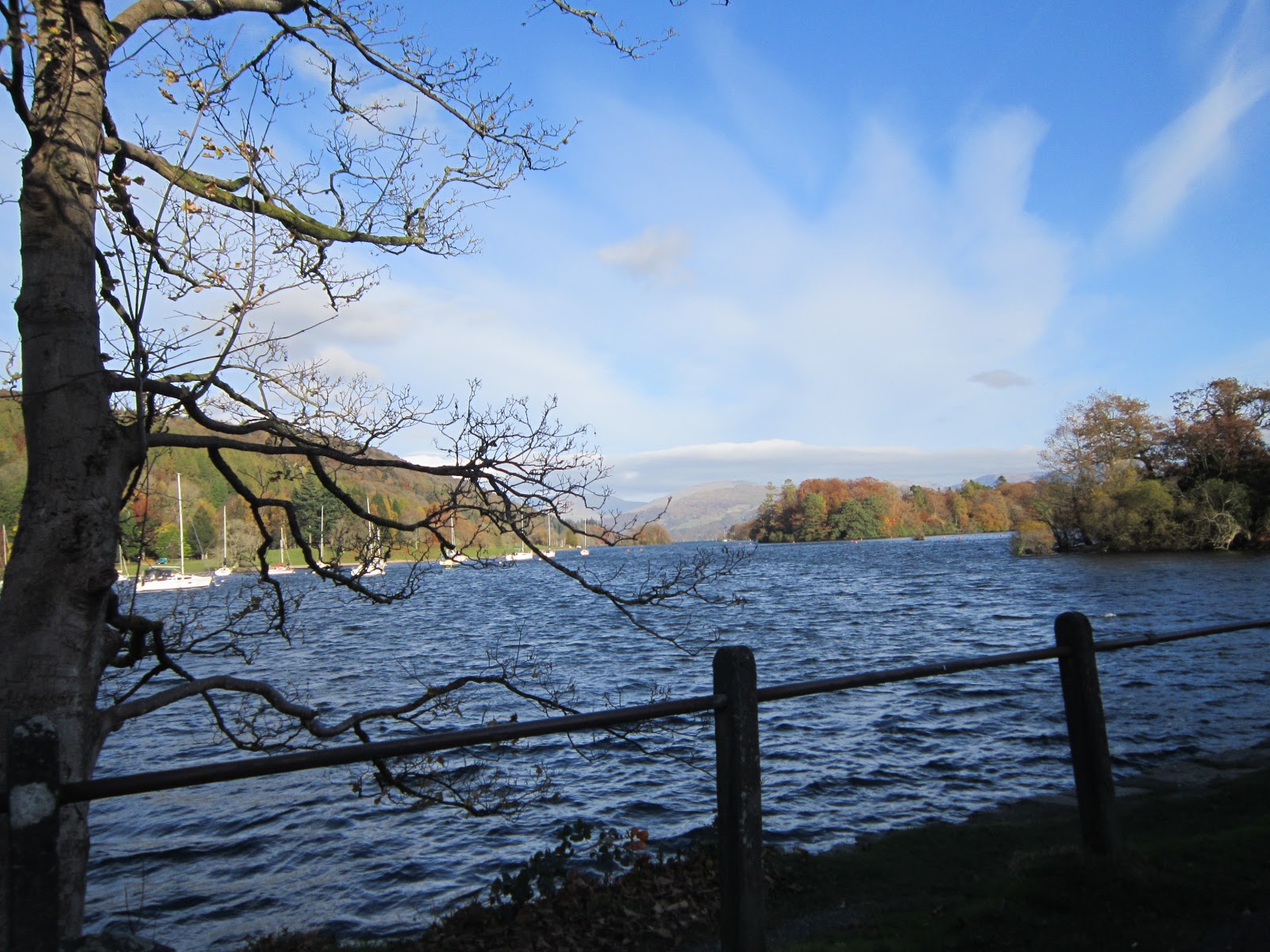
I co-ordinate with the autumn, by Lake Windermere

Sepia makes EVERYTHING like classy, doesn't it?

The sun didn't last long - Colin and I take a walk over to Ambleside,
and it was cloudy and rainy - but still beautiful.
I don't think the Lake District could be unbeautiful if it tried.


Monday, 5 November 2012

Shrinking Violet

cover design: Suzi Ovens
I have read my first Kindle book!  Before you ebook-fanatics get too excited, I should say that it was on Kindle for PC, and the only reason I read it was because it was written by a lovely friend of mine.  But if it weren't good, I'd have read it on the sly, and never mentioned it here.  As it is, I can  happily and honestly say that it is brilliant - without any fear of compromising my integrity (which, post-Dewey, is probably in shambles anyway.)  It's Shrinking Violet (2012) by Karina Lickorish Quinn, and the ebook is available for only 77p!  Considering how fab it is, that is a complete steal.

I was lucky enough to see an early draft of some chapters, because Karina wanted to know my opinion - I was a little nervous, in case it wasn't good, but I was able to give her a double thumbs up with complete enthusiasm.  She has very sweetly given me a 'thank you' on one of the opening pages, which is rather thrilling!  Ok, now onto the book itself - I just wanted to lay all that before you, so you'd know in advance my connection to Shrinking Violet.  But I hope you know me well enough to know that I wouldn't say it was great if I didn't believe it.  But I will be calling the author 'Karina' rather than 'Lickorish Quinn', because I've known her for seven years, and it would feel odd to call her anything except Karina.

Shrinking Violet could have been written to my requirements, so perfect is it for my taste.  It's a quirky, slightly surreal but not macabre, novella about Oxford - and it's heavily influenced by Lewis Carroll's Alice (as I will discuss later).  I also detected a lot of similarities with Barbara Comyns' Who Was Changed and Who Was Dead (one of my favourite books) but I know they were coincidences, since Karina didn't read the Comyns novel until after she finished writing the book.  I love a quirky domestic setting, and I was drawn in by the lovely description of Violet's house...
It was true that it was a most impractical house. Violet’s family lived in a higgledy-piggledy house with seven floors, because no two rooms were level, but each was connected by a set of stairs to the other. The house was also full of doors here and there of all shapes and sizes leading to cupboards and passages or to nowhere at all. There was not a single right angle in it. Under every piece of furniture was wedged a notebook or a folded handkerchief to stop them from wobbling on the uneven floors. Every breakable object was stuck down with glue or adhesive tape. Not even the pictures on the walls could be balanced in such a way as to hang straight.
Violet herself is an inquisitive young girl as the story starts, short for her age and with an unusual perspective on life.  Karina captures really well the disjointed nature of a child's view - a determination to read some sort of logic into any scenario, alongside the readiness to accept or imagine anything.  Violet can be quite literal in her understanding of what people say, but lends her own enchanting interpretations to the world around her:
“What I do not understand,” Violet had said “Is that when you tell me I have eleven apples and to take five away, you do not tell me where those five apples should go.”   
Her teacher had given her five minutes standing out in the cloisters for that remark. Violet did not very much fancy the idea of standing out in the cloisters today, so when she was told she had five goats and she should take three away, rather than asking her teacher where she should put the three goats, she used her own initiative and sent them to wait in the quad with the other animals that were swimming and paddling there. I am very sorry to have to send you out, she explained to the goats. But you see my teacher does not have time for my questions and you know you cannot stay in the classroom, unless you want to do some sums, and I am afraid there aren’t any spare desks for you.  
Violet sighed as she turned the page to find that every question involved the taking away of a certain number of elephants and cats and ferrets from a larger group of elephants and cats and ferrets, so that very soon the quad was filled with her cast away creatures.
Onto that Alice mention I made earlier.  Karina uses the legacy of Alice very cleverly.  It isn't intended to be a subtle background reference once or twice - it swirls and unfurls throughout Shrinking Violet, like the flood which carried the knitting sheep, perhaps.  Karina's novel isn't a sequel to or a retelling of Carroll's Alice, but it could perhaps be found in the same universe.  The influence threads through the minutiae of the novel - there are mentions of a Dodo, jam tarts, pocket-watches, chess - but it is the feel of Shrinking Violet which truly unites the two.  Where Carroll's books have their own curious anti-logic, Karina takes on the surreality of Alice, but mostly in Violet's unusual view of the world, rather than that world itself.  The narrative slips into the little girl's imagination, so that her curious conclusions and conversations with the inanimate sometimes seem to be coming true, but this simply indicates the vividness of the world she inhabits and creates.  As she grows older (and taller - like Alice, her height suddenly increases, although it doesn't oscillate...) the world around her becomes less fantastic, but the tone never loses its wonderful surreal qualities - but a surrealism rooted in the domestic.  The events of the novel could certainly happen - a school day, a wedding, a funeral - but they take on their own peculiar, touching, curious character through Violet's eyes and Karina's words.

One of the stylistic traits which Karina uses wonderfully is the off-balance end to sentence or paragraph, often adding a little pathos to a quirky character or, alternatively, adding an unusual twist to an otherwise grounded section.  Here is an example of the former:
Aunt Dora was rarely awake and even then, barely. It was often said of her that she could sleep anywhere and did. When she was young she had found it impossible to sleep in silent or solitary places and so had paid to visit museums, watch films and take train journeys just to sleep where there would be noise and crowds. She had slept through an opera, a circus show and a riot. None of her family knew this about her because she saw it as a rather sordid secret. Her friends did not know it because she did not have any friends.
This pathos comes most affectingly with Violet's grandfather Julius.  To my mind, he is the most delightful character in Shrinking Violet.  Somehow he is both eccentric and straight-talking.  He doesn't beat about the bush, but his world is almost as fanciful as the infant Violet's.  He once wrote a great novel, but now writes haiku on bits of paper and leaves them around the house.  His interactions with the everyday world - with his granddaughter's wedding, or his wife's illness - are fragmented and uncertain, but he is still in control of his personality and his opinions.  He's a fascinating character - and it is with him and Violet's relationship with him that the sadder, more serious undertones of the novel come to light.

For a short novel, an awful lot is packed in - but, unlike a lot of first novels, I didn't feel that Karina was trying to put too much in.  There is a definite unity to Shrinking Violet, in terms of style and tone, which suggests a much more experienced novelist.  Perhaps it is not entirely clear how Karina will write when detached from the deliberate influence of Alice's Adventures in Wonderland, but I think her ability to depict the quirky alongside the moving can be transferred to her next book, without the allusions to Alice.  I'm looking forward to finding out what happens.

As a friend of Karina's, I want to say "Buy it! Read it! Blog about it! Tell your friends!", but as a reader of books, I need no sort of nepotism simply to say "Buy it! Read it!"  It's a really wonderful little book, and I'm proud to have any connection with it - Karina is a talented and imaginative writer, Violet is a wonderful character, and Shrinking Violet is a joyous, eccentric, thoughtful little beauty of a book.

Premature Delivery!


By Erin Cashman

I began my writing career in elementary school, always jotting down stories and poems. It has always been my dream to be an author, but my father encouraged me to go to law school, so that I could support myself. I took his advice, and stopped writing anything except legal briefs and memos for several years. And then one night I had the strangest dream about a family of vampires. I just had to write it down. I finished it a year later, and sent it off to agents and publishers, certain I would realize my dream and become an author. Boy was I wrong. After  Twilight, romance vampire stories were in demand, not middle-grade adventure ones. And then I wrote another middle grade adventure novel, about a long lost Irish treasure. This one would certainly be published, I thought. Wrong again. And then I wrote The Exceptionals. I sent it out to only ten people; pretty certain it would not be published. A few weeks later I had an agent and a publisher, both from those ten letters! So after years of writing, and two novels behind me, I was finally going to be a published author. Third time was a charm! I was elated.

Two years and several drafts later, my novel was finally finished. April 1, 2012 was the publication date. (The fact that it was April Fools Day should have been a warning!) In December I received my advanced reader copy in the mail.  And then I realized I better get on facebook (I know, about a year later than I should have!) and create a website. I contacted bloggers and offered an advanced reader copy of The Exceptionals for their giveaways. I scheduled a pre-publication blog tour, and had a strategy in place -- for the next two months I was going to do everything within my power to get The Exceptionals as much pre-release publicity as I could. Soon The Exceptionals was available online for pre-order, and all of my friends did just that. This was really happening!

Bursting with excitement, I painstakingly planned my release day. A fabulous independent bookstore offered to host a release party on April 1. A friend offered to make hawk shaped cookies (after Ferana, an important character from the book). Following that would be a nice dinner with my family. It was going to a perfect day. On February 1, I was at work doing some legal research when I received about a dozen emails from friends and family. Their copy of the The Exceptionals had shipped! That just couldn’t be, I thought, it won’t be available until April 1.  I had two months to get ready for the release, two months I needed to help promote the book!

Frantic, I emailed the only other author I had ever been in contact with, Julie Wu, who had already been very generous with her time and advice. She quickly emailed her author group – Book Pregnant – on my behalf. Had anyone heard of this? No. The next day my agent called and delivered the news: nothing could be done. The book was now available.

What did I do? I cried and felt so sorry for myself. But the next day I woke up and thought, Right now I am officially a published author. It may not have happened how I had planned, but I had realized my dream, and I should be thrilled. For years and years I worked hard, on three different novels, and I was so fortunate to finally be published. And then I met Julie for lunch, and she invited me to join Book Pregnant. I did, and immediately I was flooded with congratulations and well wishes on my release. It’s hard to believe it was only nine months ago, because the authors of book pregnant have become very important to me. It’s such a supportive community. We share each other’s successes, but more importantly, the disappointments.

Authors don’t control very much. They don’t pick their release date, they certainly can’t control what reviewers write, or what readers think. Often, authors don’t have control over their covers – sometimes even their titles! They work tirelessly on their manuscripts, edit again and again, and then, if they are very lucky, one day hold their published book in their hands. And then it’s up to everyone else to decide if it’s good or bad, worth reading or not. As exhilarating as it is to see your book in print, it’s scary, too. First time authors often have many questions (me more than most!), some highs and plenty of lows. Having others to ask questions to, go to for advice, vent – and know that no matter what, they are always in your corner, has been a blessing.

So in retrospect, I am glad that I debuted two months early. If I hadn’t, I probably would not be in Book Pregnant. I may have lost out on some pre-publicity buzz, but what I gained is far more important.

Sunday, 4 November 2012

My Life in Books - Series Three over!


Thanks so much to everyone who participated in My Life in Books this year - another great line-up of wonderful bloggers, and lots of inspiring choices.  This is just a short post to say how much I enjoyed the week - and it seems like you all did too - because I wanted to leave the focus on people's answers before moving on to reviews etc.  Do go back and read, comment, visit their blogs etc.

I intend to another series next March, I think - if you would like to be considered as a participant, or can think of a blogger whom I've yet to ask (first two series archive here, and I'll put up an updated version soon) then let me know!

Coming up in the next few weeks - photos from my holiday, including my first ever pumpkin carving; I do a u-turn on a famous novelist; a funny sequel; a brilliant novella which was my first Kindle [for PC] read; a really lovely children's author's memoir - and, on Wednesday, my birthday!

See you soon.

Saturday, 3 November 2012

My Life in Books: Series Three: Day Seven


Frances blogs at Nonsuch Book, and I shamelessly stole the idea of centered, lower case post titles from her... thanks, Frances!

David blogs at Follow The Thread, and is (I think) the only person other than me who attended both the Bloggers Meet-Ups I organised a while ago! [EDIT: Oops, no, he wasn't!]


Qu. 1.) Did you grow up in a book-loving household, and did your parents read to you? Pick a favourite book from your childhood, and tell me about it.

Frances: I did grow up in a book-loving household. A seriously book-loving family. My grandfather and his sister never said no when it came to a book and some of my best memories from childhood are of book shopping expeditions. All those possibilities! I was read to frequently by all members of my extended family but they did take to hiding my favorite book, The Lorax, because I cried every single time when we reached the end and the Lorax picked himself up by the seat of his pants and disappeared through the grey clouds.

David: I’ve always been around books and words, though I don’t think I’d say my household was more book-loving than the average. My father in particular has read books as long as I remember, but I wouldn’t describe him as a true bookworm – I’ve always been the most bookish person in my family. I was read to as a child: the Munch Bunch books were my mum’s main books of choice, and the Mr Men were my dad’s. Richard Scarry’s work was another childhood touchstone – I remember a book of 366 stories and poems, one for every day of the (leap) year.

My reading as a child took in myths and legends, books of obscure or humorous facts, fiction, poetry, and more. Given that, it’s hard to just choose just one book, but I’ve gone for Can You Get Warts from Touching Toads? by Peter Rowan. It’s a collection of answers to kids’ medical questions, such as whether eating bread crusts makes your hair curl, or whether it’s better to run about or fall asleep after Sunday lunch. I had great fun browsing this book, and the Quentin Blake illustrations only added to that (I can still remember one of the grandfather who claimed he could blow pipe smoke out of his ears).


Qu. 2.) What was one of the first 'grown-up' books that you really enjoyed? What was going on in your life at this point?

Frances: Every Christmas, my family would listen to a recording of A Christmas Carol on Christmas Eve, and I just loved that. Got it into my head that I could read Dickens when I was much too young to appreciate but I persisted. No wonder that re-reading Dickens as an adult was a completely different experience than those childhood reads. :)

David: Terry Pratchett was my bridge between children’s and adult fiction. I first got into his work through the wonderful animated version of his novel Truckers; moving on to the Discworld books in my mid-teens was a natural progression. There are so many I could choose, but Wyrd Sisters is one of my favourites. The book great fun for Pratchett’s humorous riffs on Shakespeare (“When shall we three meet again?” “Well, I can do next Tuesday”). But it’s also an incisive exploration of one of his main themes as a writer – the ways we use stories to shape the world. For all Pratchett’s success, I think that aspect of his work is significantly underappreciated.

I also have to mention Wyrd Sisters because it was one of the texts I used in my A Level English Language coursework project, comparing the humour in three comic fantasy novels. That was a busy and enjoyable time - and probably one of the first occasions when I really thought about how my favourite books worked.


Qu. 3.) Pick a favourite book that you read in early adulthood - especially if it's one which helped set you off in a certain direction in life.

Frances: The World According to Garp. But that is a deeply personal story.

David: Summer vacations from university were a great opportunity to get some concentrated leisure reading done. In the summer after my second year, there were two large books in particular that I wanted to read. One was China Miéville’s Perdido Street Station; as that’s become the better-known of the two, I’ll concentrate on the other one here. Mary Gentle’s Ash: a Secret History was one of the first books I read because of online reviews: the vast (1000 pages, though it reads quickly) tale of a female medieval mercenary, which proves in time to encompass much more than that. I devoured it in a week and can still remember the experience. (Incidentally, both Ash and Perdido Street Station were shortlisted for the Arthur C. Clarke Award; this was one of the first years I paid attention to the shortlist, which has since become a highlight of my blogging year.)

Qu. 4.) What's one of your favourite books that you've found in the last year or two, and how has blogging changed your reading habits?

Frances: A History of Love by Nicole Krauss is one of the most beautiful books I have ever read, but I have to say that some of the best reading experiences I have ever had have been because of my blogging life especially with my on-too-long-a-hiatus online book group, The Wolves. We have read the treasured together (Virginia Woolf) and all manner of new things. It is how I came to the infinitely playful Perec, Conversation in a Cathedral and many other wonders. I came to blogging for the conversation and that satisfied the want and then some.

David: Blogging has broadened my reading habits, and helped me to see that what I really like is not a type or genre of book, but a set of qualities that I can find in all sorts of books. I’ve also become interested in reading new literature, and seeing what writers of my own generation have to say. So the book I’m going to choose here is Mr Fox, Helen Oyeyemi’s journey through different versions of the Bluebeard story. When I read a writer like Oyeyemi, I know that the future of literature is in good hands.


Qu. 5.) Finally - a guilty pleasure, or a favourite that might surprise people!

Frances: I read comic books. Have always been a big Thor fan. All the Nordic myth stuff plus the fact that he sacrifices his godlike status to dwell and live among humans in part.

David: I don’t really think of myself as having guilty pleasures – if a book is a pleasure to read, there’s a good reason for that, and I don’t see a need to feel guilty over it. Which leaves me with a book that might surprise people…

I’m going to say Agnes Grey by Anne Brontë. I only read it this year, but I’m choosing it because I think it’s a sign of where I am as a reader right now. I’m not as well read in the classics as I’d like to be, and there was a time when I wouldn’t have chosen to read a novel like Agnes Grey. But I really liked it, and appreciated it in ways that I wouldn’t have previously. That’s how I know I’ve grown as a reader, and I hope I will continue to do so in years to come.


And... I've told you the other person's choices, anonymously. What do you think these choices say about their reader?

David, on Frances's choices: This reader has chosen a classic ghost story and a work based on Greek myth, so there's an interest in traditional tales here. Anyone who would choose a Dr Seuss title as a childhood favourite surely loves language. Put the two together, and I think you have someone who appreciates storytelling - it wouldn't surprise me if this person enjoys the spoken word as well as the written. The Thor comic makes me think of grand, sweeping action; and the Irving and Krauss books tell epic stories about individual lives - so I'd say this person enjoys books with a large or small focus. Definitely someone who'd be interesting to talk books with!

Frances, on David's choices:  At first glance, this list seemed to suggest a very clear picture of this reader - inclined to the fanciful but only in a smart and sometimes irreverent form. A reader with a sense of humor certainly. Perhaps a subtly wicked sense of humor. And then I get to the end of the list and see Agnes Grey by Anne Bronte and became suspicious that this exercise is not "determine a portrait of this reader" but a "which one of these things is not like the other" proposition. Another excellent novel on the list but stark, purposeful and loaded in its intent in a way not present in the others. This must be a reader that has an obvious passion in his/her reading choices but with depths and range not immediately obvious.

Friday, 2 November 2012

My Life in Books: Series Three: Day Six


Laura blogs at Laura's Musings, and has been the brainchild between the year-long celebration of Elizabeth Taylor throughout 2012.  Thanks, Laura!

Jodie is better known to most of us as Geranium Cat, and was (I believe) one of the first bloggers I met in person.  Lovely!


Qu. 1.) Did you grow up in a book-loving household, and did your parents read to you? Pick a favourite book from your childhood, and tell me about it.

Laura: My mother was an avid reader and always had something on the go. To this day I can picture her curled up in her "reading chair." She made sure I learned to read before starting school, and took me to the library on a regular basis. I outgrew the library's juvenile fiction before I was old enough to receive an adult library card, but was given one with a special designation that allowed me to check out all but the most "mature" books.

When I was very young I received several books by Joan Walsh Anglund as gifts, and I adored them. They are small books that fit well in a child's hand, with very sweet illustrations and titles like Love is a Special Way of Feeling and A Friend is Someone who Likes You. Their central message was all about being loved and caring for others. I remember having them read to me, and then reading them on my own. They were a regular source of comfort, and even now their covers bring back warm feelings.

Jodie: Yes and yes. I adored books and was encouraged and read to by everyone around me. One grandfather read Winnie-the-Pooh and Christmas Carol to us “with voices” and Granny was wonderful both at reading Alice and at making up stories. My favourite book from my early childhood was Barbara Sleigh’s Carbonel, about a girl who buys a witch’s cat and has to free him from a spell. It’s the first book I can remember reading to myself, because everyone else was too busy that day. I’m sure learning to read wasn’t quite that straightforward, but it’s a book I still love.

Qu. 2.) What was one of the first 'grown-up' books that you really enjoyed? What was going on in your life at this point?

Laura: I read Jane Eyre one summer, I think I was about 12. At that point, this was the longest book I'd ever read. I entered a local bookstore's summer reading competition, so who knows why I chose such a long book! I remember taking it with me to summer camp, partly because I was enjoying it, but more than anything I wanted to win the competition! I didn't win, but I did well enough to earn a small gift certificate. And Jane Eyre definitely sparked my interest in classics and made me more willing to approach books others might consider difficult.

Jodie: As soon as I was old enough to go to the library alone I was sent every week (not that I needed encouragement) to choose books for my father to read on the theatre switchboard when there were no lighting changes and, inevitably, I read them too. So I grew up on a diet of crime and science fiction – H.P. Lovecraft, James Blish, John Creasey, Robert van Gulik…I definitely shouldn’t have been reading van Gulik’s The Haunted Monastery at whatever age I was then (probably about 12), I was distinctly shocked by it, but I’ve got it on my bookshelf now, so I think it should get the “first grown-up book” category. Choosing those books certainly shaped my own reading habits though, because I had to be discerning; I couldn’t simply take 4 books off the shelf and hope that they’d do.


Qu. 3.) Pick a favourite book that you read in early adulthood - especially if it's one which helped set you off in a certain direction in life.

Laura: In the mid-1990s, I joined a book group with a lot of fantastic women, all older than me and great role models. One of them introduced me to The Mists of Avalon, by Marion Zimmer Bradley, a retelling of the Arthurian legend from a female perspective. At that time, I was just becoming aware of the way history, myth, and legend can differ based on who's telling the story. Mists sent me off on a period of reading alternative points of view and learning about the often unsung role of women in history.

Jodie: I think that has to be The Once and Future King by T.H. White, because after I read it I became quite obsessed by myths and legends, something which has never changed. Following the trail started by White led to so much other literature, from his contemporaries like Sylvia Townsend Warner to his sources, such as Malory and Sir Gawain and the Green Knight. I love multi-layered fiction, and I think White was my first experience of it. Um, the only thing that’s wrong with this answer is that I read it when I was 12, but it really is the well from which all my interests spring.

Qu. 4.) What's one of your favourite books that you've found in the last year or two, and how has blogging changed your reading habits?

Laura: In the recent past I've discovered two wonderful authors: Winifred Holtby and Molly Keane, who wrote two books that landed on my list of all-time favourites: South Riding and Good Behaviour. Both are Virago Modern Classics, which have had a profound impact on my reading habits (and my pocketbook)! When I started blogging in 2007, I read a lot more contemporary bestsellers, mixed with some classics but mostly ones typically taught in school. I discovered Virago Modern Classics through LibraryThing, and have been introduced to so many fine women writers I never would have discovered otherwise.

Jodie: The recent favourite is easy – Angela Thirkell’s August Folly, the first of her books that I read. I came to blogging almost through despair – that’s hardly too strong a word. Five years ago I had read everything that I could face on the library shelves, a nauseating cocktail of chicklit, inferior crime writing and poorly-written fantasy. I was utterly miserable but I decided that the Internet must be good for something by then and started looking for recommendations by people who liked the same sort of books as me and bombarding the library with requests for books – oh yes, and buying them. I no longer wait for a good book to come to me by chance, I actively pursue them, as far as I can afford to, and the proportion of newly published books I read has gone down considerably. I still read crime and fantasy, but I can be much more discerning, and I won’t finish a bad book just for the sake of having something to read.


Qu. 5.) Finally - a guilty pleasure, or a favourite that might surprise people!

Laura: This is difficult to answer because I don't usually read for escape, or for guilty pleasure. But since most of my reading tends to be "heavy" stuff, I do need a break occasionally. Then I find that mystery or crime novels, which I rarely read otherwise, can be just the ticket. Most recently I escaped into Gillian Flynn's Gone Girl and have enjoyed C.J. Sansom's Matthew Shardlake mysteries, set in the Tudor period.

Jodie: Well, not exactly guilty, but this one has not only spent the last year on my bedside table, but I regularly take it with me when I’m away from home. It is The Illustrated NFL Playbook, subtitled: “Pro football explained in diagrams, charts and definitions”…I should explain for those to whom the letters “NFL” mean absolutely nothing that this is American football, as mysterious to the uninitiated as cricket (which I loathe, along with virtually every other form of sport I can think of). All I can say in my defence is that it has proved a wonderfully safe topic to steer conversations towards on those occasions when my three large menfolk disagree (sometimes joined, I’ll admit, by me) on quantum computing, or whether pecorino is better than parmesan, or what to do about the Palestinian question. At such times all I have to say is, “Who do you think has the better defensive line, the 49ers or the Bears?” and they’ll be throwing statistics around for hours. The funny thing is, I’ve started to really enjoy it…


And... I've told you the other person's choices, anonymously. What do you think these choices say about their reader?

Jodie, on Laura's choices: There were two books I didn’t know at all. Googling Love is a Special Way of Feeling by Joan Walsh Anglund shows that it looks very sweet, and ideal for parents to read with their child sitting on their knee – a book for sharing. I’d guess that this is someone who grew up in surroundings where books were treasured. South Riding - Winifred Holtby and Good Behaviour - Molly Keane? Well, I suspect that this person’s bookshelves may have quite a few volumes with dark green spines and probably a collection of Persephones too? And that they probably like secondhand bookshops and would much rather read a book published last century than the latest bestseller. In The Mists of Avalon, by Marion Zimmer Bradley, I think I might detect a fellow lover of myths and legends? Definitely a romantic, at any rate, though, taken along with Jane Eyre, perhaps a romantic with a sense of restraint. Something these books have in common is the strength of their female characters: even quiet Jane refuses the safe option, while Sarah, Aroon and Morgaine struggle against the dictates of their worlds. Finally, Gone Girl by Gillian Flynn – this is the other book I don’t know, but I think all these choices tell me that this person is interested in how people and relationships work and in the role of woman in society, and is someone who looks for emotional integrity in their reading.

Laura, on Jodie's choices: I felt a bit anxious to begin with, because I'd never heard of Barbara Sleigh or Robert van Gulik. Thank you LibraryThing for filling me in! This reader strikes me as an anglophile whose lifelong reading has been shaped by a love of fantasy. I was excited to see The Once and Future King as their early adult read, since I was strongly affected by a woman's version of the same tale. The Angela Thirkell is really different from their earlier choices, which makes me think this person is open to new experiences at least in reading, and possibly in life as a whole. But I have to say, The Illustrated NFL Playbook had me scratching my head. I'm guessing this person has a great sense of humor, having thrown in a selection so different from the others. There has to be an interesting explanation, and I can't wait to read their what they have to say!

Thursday, 1 November 2012

My Life in Books: Series Three: Day Five


Lisa blogs at A Bloomsbury Life, and gives me daily life-envy.  But it's impossible for me to hate her, because she's so funny and sweet and has Persephone Books in her blog banner.

Jane is better known to most of us as Fleur Fisher, and her distinctive style and excellent taste make her a daily must-read.


Qu. 1.) Did you grow up in a book-loving household, and did your parents read to you? Pick a favourite book from your childhood, and tell me about it.

Lisa: One of my earliest memories is seeing my mother curled up with a book in a Saarinen Womb chair while my four younger siblings wreaked chaos around her. She had escaped to somewhere else completely and I remember wishing I could follow her! She was a voracious reader and read to me all the time. I had my Enid Blyton phase and my Jean Plaidy phase but it was The Last of the Really Great Whangdoodles by Julie Edwards (i.e. Andrews) that clicked on a light bulb for me. The children in the book use “thinking caps” to take them to the fantasyland of the Whangdoodle. It struck me that our imaginations are the only super-powered vehicle we need to make our dreams come true. And that if we work toward something and think positively and don’t give up, there’s no limit to what we can achieve.

Jane: My parents were both readers, and there were always books in the house. Over the years they built up a collection of books that they wanted to keep, and borrowed many others from the library. My baby book records that my first walk was through the Morrab Gardens to the public library. 

I remember being given classics for birthdays and at Christmas, being encouraged to spend my pocket money on books rather than sweets, and regular library visits. Best of all though were the book than my mother had saved, hoping that she would have a daughter to share them with one day.

And the very best of those was Little Women by Louisa May Alcott. It was a lovely hardback edition, but we’ve read it so many times between us that it is coming to pieces. I wanted a sister, but she never arrived, and so a story of four sisters was quite irresistible. I loved that they were so different and yet they were such a close family. I loved their different stories, and I felt so many different emotions as I watched their lives unfold. It was all utterly real to me – it still is – and I wasn’t at all surprised when I discovered that the book was inspired by the author’s own family.


Qu. 2.) What was one of the first 'grown-up' books that you really enjoyed? What was going on in your life at this point?

Lisa: I read Atlas Shrugged when I was twelve partly to be precocious and partly because a friend of my parents had asked me, “Who is John Galt?” and of course I had to find out. A lot of Ayn Rand’s moral relativism went over my head but her strong-willed protagonists were potent role models for a shy middle-schooler whose life resembled The Diary of a Wimpy Kid. I think it was the first time I realized that I had a choice in life: I could follow the herd or I could follow my heart. And that if I chose the latter, I needed to stop worrying about what people thought of me and start making my own damn decisions.

Jane: I remember, in my first or second year in secondary school, an English exam with a comprehension test that used a passage from Far from the Madding Crowd by Thomas Hardy. I loved his rich, descriptive prose and I picked up a copy of the book from the library not long after. I loved the language, I loved reading about country life, and I loved the story that Hardy span around Bathsheba Everdene and her three suitors.

After that I read my way though every book by Thomas Hardy I could find, and I looked closely at anything I came across that was dressed in the black garb of Penguin Classics. The Brontes came next, then Wilkie Collins, then George Eliot. And when I saw a book that looked very similar, but was dressed instead in green, I picked that one up too, and discovered Virago Modern Classics. But that’s another story.


Qu. 3.) Pick a favourite book that you read in early adulthood - especially if it's one which helped set you off in a certain direction in life.

Lisa: Easy. David Copperfield. I read it sophomore year of college and for a long time afterwards, it was my favorite book. It’s all about the triumph of character over circumstance. Dickens tells us, “Look. Life is a struggle, but it’s important to suck it up and keep plugging along because unimaginable joy could be just around the corner. And if things go wrong, it helps if you try to find the funny.”

Jane: When I came home from university for Christmas one year my father told me that he’d bought my mother a book. The Sunne in Splendour by Sharon Penman: a big historical novel about Richard III and the end of the Wars of the Roses, painting a more sympathetic than usual picture of the last Plantagenet king of England. I wasn’t at all sure she’d like it. In those days my mother usually read romances and family sagas, historical novels, and I had no memory at all of her reading historical fiction.

When I came home next, for Easter, the bookmark was still just a few pages into the book. Just before I left my mother told me that she didn’t like it at all, but she thought that maybe I would. I started reading on the train back to London and I was smitten. It brought a period and characters I had known little about to life and it brought it home to me that history was rewritten by the winners, that there could be very different interpretations but on the same facts. I’d read a little historical fiction before then, but since then I’ve read a great deal more.


Qu. 4.) What's one of your favourite books that you've found in the last year or two, and how has blogging changed your reading habits?

Lisa: I read Beware of Pity by Stefan Zweig a few years ago and its intensity still haunts me. I think of Zweig’s writing style as Sigmund Freud meets F. Scott Fitzgerald. It’s psycho glamour. In the novel, an innocent act sets off a chain of events which spiral to a horrifying conclusion. The tension is so palpable that it feels like it was written in one long breath. I’ve now read everything he’s ever written.

And yes, blogging has started to change the way I read. Blogs are the 21st century version of a 19th century literary salon. I love hopping from site to site and listening to a miscellany of different voices and perspectives – the mash-up can create some incredible connections. Lately, I’ve been doing the same thing with books. Right now, I’m alternating between Thomas Mann’s Buddenbrooks (dense, fascinating) and Hilary Mantel’s Bring Out the Bodies (a thrill ride). Reading both together feels like a richer experience.

Jane: There was a point in my life, a little over six years ago, when I had to store a lot of my books in boxes in the attic. I decided I needed to catalogue them, so I knew what I had and where it was, and after a bit of looking around I decided that LibraryThing was just what I needed. Not long after I’d started entering books an invitation to join the Virago Modern Classics Group landed. It was wonderful to find that there were so many people, in so many places, who still loved those green books, and those people led me to new books, new publishers, new places to find books. Blogging came a little while later, as I found some lovely blogs when I explored ‘similar libraries’ and found myself wanting to write a little, to fix the books I was reading in my mind.

All of that didn’t so much change my reading habits as make me realise that because there were so many books out there I had to be a little more selective than I’d been in the past. And that it was always worth picking up an unknown title by an unknown author if the book caught my eye, just in case it was a lost gem waiting to be revived by one of those lovely reprint houses.

And that brings me to Love in the Sun by Leo Walmsley. I picked it up, from the Cornish fiction bookcase in the Morrab Library, because I knew people with the same name. There didn’t seem to be a connection, but the dust jacket was beautiful and an enthusiastic introduction by Daphne Du Maurier (a friend and neighbour of the author) told me that I had to read it. I found one of those lost gems.

A man and a woman from the north-east were in love, but their situation was complicated, so they ran away to Cornwall. They leased an old army hut and struggled to live off the land, while he wrote a novel. Love in the Sun is fact rewritten as fiction, honestly, thoughtfully and beautifully written. It was out of print when I read it, but I was thrilled to hear from the Walmsley Society that they now have it back in print, in a very nice new paperback edition.


Qu. 5.) Finally - a guilty pleasure, or a favourite that might surprise people!

Lisa: I am starting to feel guilty that I might be too insistent that my friends read Beverley Nichols. His Merry Hall memoirs are so wickedly funny. Beverley writes like he’s Noel Coward lost in a P. G. Wodehouse novel and I want to live in every house he ever writes about. If I’m feeling clever-deficient, I read a few pages of him and my wit comes snapping back.

Jane: I don’t really believe in guilty pleasures. Books can offer so many different things, and I think the trick is picking the book that offers what your head and heart need at any given moment. And if sometimes that’s great literature and sometimes its chick lit, so be it. I’m not sure what might be surprising either, because I can see a thread that runs through pretty much everything I read.

But maybe this is the time to confess that I sometimes read to Briar (my border terrier) from The Dastardly Book for Dogs by Rex and Sparky. Santa Claus left it for her a few years ago and she has learned a great deal from it. How to pick a pill out of peanut butter; what to do during a thunderstorm; building a bed out of your owner’s laundry; the formal rules of fetch; making toys out of household items ...


And... I've told you the other person's choices, anonymously. What do you think these choices say about their reader?

Jane, on Lisa's choices:My initial reaction was that I have no idea, and that I don’t think we’ve ever crossed paths.
Then I thought a little more and I decided:
1) This is someone who is very purposeful, and not afraid of hard work.
2) This is someone who lives in a city or a big town, not in the country or by the sea.
3) This is probably a cat person rather than a dog person.
but it wouldn't surprise me at all of I'm wrong on all counts.

Lisa, on Jane's choices: How fun! Let me put my Miss Marple hat on…and away we go. First of all, Little Women suggests someone who understands the struggle between family devotion and the desire to be independent and live your own life. With Love in the Sun, I'm envisioning someone who is passionate about adventure and life’s simple pleasures. Including The Sunne in Splendor with its empathetic perspective of Richard III makes me think this person doesn’t rush to judgment and has faith in the power of redemption. He/she also possesses a great sense of humor about the absurdities of modern life (The Dastardly Book for Dogs) and has a deep and haunting empathy for the vagaries of human nature (Far From the Madding Crowd).

So to recap: This person is fair-minded, optimistic and always gung-ho for adventure, has a keen sense of the absurd, a deep passion for domesticity and family and looks on life's tribulations as being exciting opportunities for personal growth. Who says the perfect person doesn't exist?!