Thursday, 22 August 2013

The Play's The Thing

The review I intended to write today hasn't happened, as editing a chapter of my thesis has taken over my life, but in preparation I shall ask you... what is the best performance you have ever seen on stage?

It has to be a combination of great play and great cast, of course.  And to a large extent it's a subjective assessment.  But I'm going to pick All My Sons, which I saw with David Suchet, Jemima Rooper, Zoe Wanamaker, and Stephen Campbell Moore.  Suchet, especially, was astonishing.  My thoughts are all here...

I'm recycling my theatre cartoon...

So, I'll be talking about plays tomorrow (or, ahem, soon)... and if you follow me on Twitter - @stuck_inabook, thanks for asking - you might be able to guess which book it'll be!  But... over to you!  Tell me about your experiences at the theatre!

Mr. President: Don’t Cave to the Higher-Education Lobby

Cross-posted from the Chronicle of Higher Ed.
 
Over all, I’m a fan of President Obama’s proposal to rate colleges and link the results to financial aid. The plan is to give students attending institutions rated high—on such measures as tuition and graduation rates, debt and earnings of graduates, and the percentage of low-income students enrolled—larger grants, as well as lower-interest loans. The proposal ends the “tinkering” that most higher-education reform has pursued; it aims squarely at the main drivers of college costs: private and for-profit institutions (and their happy followers, the elite public flagships) and states.

That is the approach my colleagues and I argued for in a recent paper for the American Enterprise Institute. “Recent national opinion polls indicate that 74 percent of Americans believe that higher education is unaffordable, and 92 percent of college presidents agree,” we noted. “While analysts have offered several potential explanations for this perception, one has not garnered much attention: The lack of perceived affordability may stem from the financial aid system’s strong focus on the behaviors of ‘student-consumers’ rather than education providers.” Several recent policy papers from HCM Strategists, Education Trust, New America, and others have taken a similar line.

Instead of merely tying accountability to campus aid (a paltry sum), this time Obama seems to be talking about all of the programs authorized under Title IV of the Higher Education Act of 1965, such as Pell Grants, federal Supplemental Educational Grants, Perkins Loans, and Federal Subsidized and Unsubsidized Direct Loans. He’d better be, since if he simply aims at the Pell Grant, he’ll be taking on the only need-based entitlement program that does heavy lifting. Colleges that won’t commit to providing accessible, affordable, high-quality postsecondary education should not be receiving federal Title IV funds, period.

The devil, as always, is in the details. I’m very, very wary of poorly designed accountability metrics. In elementary and secondary education, these have been a disaster, because they aim at teachers (whose performance is as much a symptom of context as a cause of outcomes), they focus on standardized tests associated with a narrow set of educational intentions, and they are focused only on public schools. That’s absurd. In contrast, higher-education accountability should be aimed at decision makers (administrators and states); and measures like how many students complete programs and degrees should be directed at all institutions receiving Title IV via their students. Don’t forget that American higher education is dominated in its rhetoric and the “standards” it sets by private institutions, which have knowingly helped the public false equate cost with quality and selectivity with “good schooling.” Clearly a different metric is required.

Obama needs to unmask the devil here, ripping off the shield behind which institutions hide. If expensive schools are so “worthwhile,” then they should be able to admit the kinds of students that public universities admit, rather than creaming off the top. If their expenses are so merited, we should see bigger gains at private elites than at we do at less-expensive institutions, not just higher graduation rates. None of that is happening now.

Obama needs to call out the bad actors in public higher education too—those institutions that fancy themselves private and, in doing so, discourage social mobility for those who need it most. His decision to stand at a New York State public institution today rather than at the quasi-private University of Michigan at Ann Arbor is a good one. He is standing to protect those comprehensive state public universities and their students.

Now, what I’m unimpressed by is that Obama felt the need to take a sideswipe at Pell recipients when releasing his plans. Why is he suggesting that we need to stretch out the disbursement of Pell Grants across the semester when there is not a shred of evidence to suggest that this is necessary, effective, or even possible for colleges to do without raising costs? I can think of just one source of this idea, a project dubbed “Aid Like a Paycheck” from the Institute for College Access and Success and MDRC, a research group. It’s really sad if Obama has been pitched this idea based on two small case studies at two exceptional California community colleges.

Look at Twitter today. Students are desperate for their “FAFSA dollars” to arrive so they can pay their bills. College costs must be paid upfront, so aid must be awarded that way too. Financial-aid officers have enough on their plates already; they don’t need to deal with multiple payments. And, most important, the mythical Pell recipients who supposedly take their aid and transfer only to get a second Pell are about as real as President Reagan’s  welfare queens in limos. You don’t need to drink that Kool-Aid and attack poor students, Mr. President: Take on the hard work of getting American higher education focused on the needs of students rather than the needs of institutions.

You can do it, and we Americans will back you every step of the way, as long as you do not cave to the private higher-education lobby. Do that, and this was all for nothing.


Tuesday, 20 August 2013

Great British Bake Off: Series 4: Episode 1

It's baaaaaaack!  And I'm back recapping - this time from the beginning of the series, which is rather daunting.  I can't promise it'll be every week, but we'll see how it goes.


Gosh, it doesn't feel a year since we last saw Mary eating like a pirate and Paul glowering at everyone, does it?  Have Mel and Sue been stuck in a room thinking up new anatomical euphemisms for a year?  (Judging on the wordplay this week... no.)  And why have no former Bake Off contestants yet appeared on Strictly Come Dancing?  I'd watch if Scottish James, Cathryn, and Sarah-Jane were there.  I can imagine Cathryn does a mean rumba.  And surely The Brend, a.k.a. The Bridge Between the 70s And Today, loves a sequin or two?

Alternatively, I suggest a show where he teaches underprivileged boys to play football.  It'll be called Brend It Like Beckham.  Thankyouverymuchgoodnight.

In preparation for the show tonight, Twitter had a hashtag #BakeOffSongs going around.  I contributed I Just Don't Know What To Do With My Self-Raising Flour - let me know if you think of anything.

It's going to be tricky, recapping the first episode before we know who everybody is, and while there are so many of them about - so I'm going to be selective rather than thorough, and try to keep an eye out for those who might become the much-loved heroes and villains of Series 4.  And this year there are a mammoth 13 bakers in the tent (which, incidentally, looks like a pretty good diagram of when you know that egg whites are stiff enough for meringue.)


They fail to mention that thirteen is a baker's dozen, which would have been rather apt.  I am, of course, lying.  They mention it so often that I'm starting think the numbers run 11, 12, baker's dozen, 14...  Indeed, this is the punniest episode I've ever seen - it even starts with a wait/weight gag, and I'll fill you in when we get to more.  Maybe even a pun klaxon.

We see a quick overview of tears, joy, cakes, and timers - and the judges get an 'aren't they scary?' edit, with people saying how frightened they are of Paul and Mary in turn.  I'm thinking the war on terror needs to turn its attention to these two, since apparently they're terrorising this baker's dozen of bakers.  (Geddit? Oh, sorry, we did that one.)

Are you ready for the laughter, the agony, and the ever-revolving cakes?  (Seriously, why do they revolve so much in these preview clips?  We never see them revolve again.)  Well, sorry - first we have to indulge Mel and Sue in a bit of light banter about surgical hoists and lacing.  They've strayed so far beyond the line of 'taking things seriously' that it now feels as though the Bake Off is a wonderful, state-sponsored crèche for them.

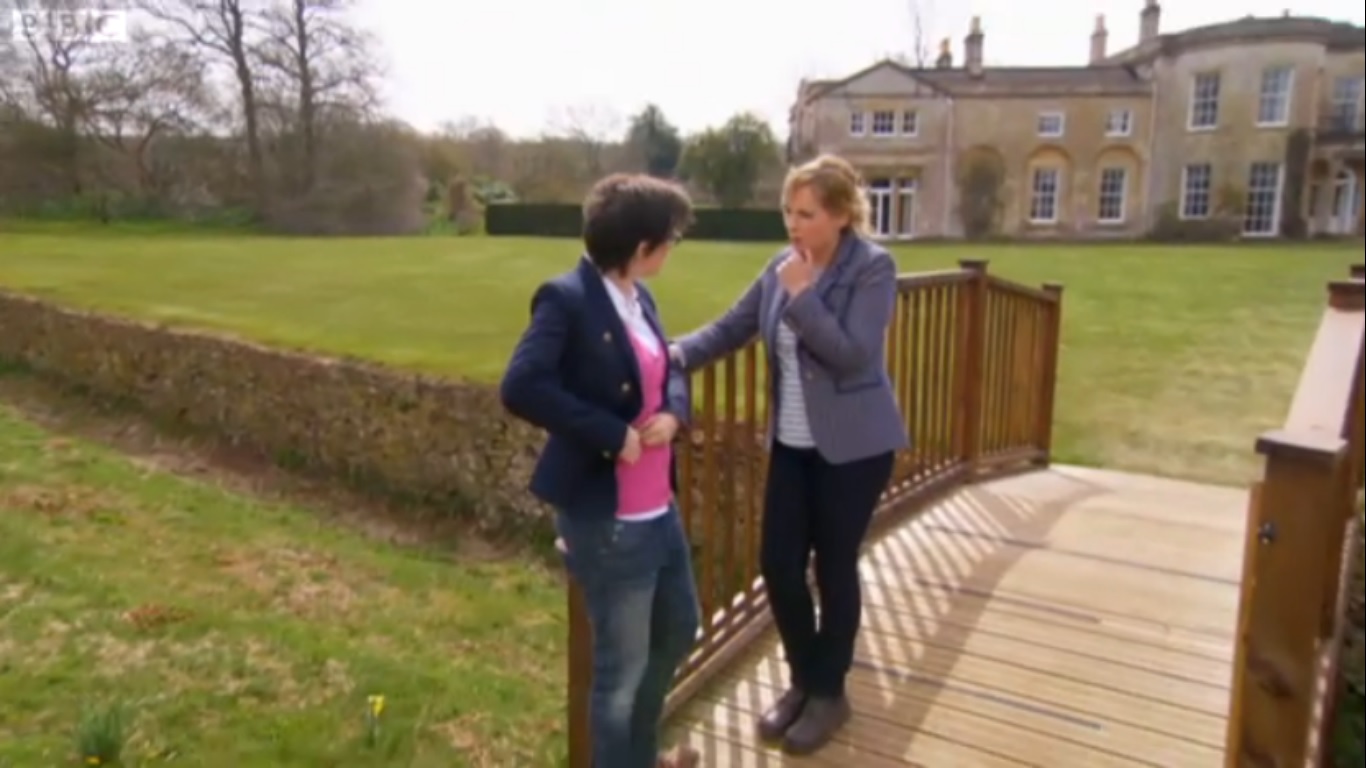
I've really grown to love that bridge.

The first challenge is a sandwich cake.  Things are pretty simple to start with, you'd have thought, but Mary Berry starkly informs us that "It is easy to make a basic sandwich cake.  We want them to go much further than that."  At this point we cross over to Una Stubbs sighing over her mixture, as though hearing Mary's words through the wall.  It's all very moving. 

Ok, it's not Una Stubbs. But I don't know her real name.

And, of course, we head over to a baker named Glenn saying that he's going to make a simple Victoria sandwich, because he thinks Mary will like the traditional.  Oh, Glenn.  Never underestimate Bezza.  She has the spirit of adventure in every pore.

Because this is the first episode, we get all those curious videos of the contestants at home, not interacting with the camera at all, and rather giving the impression that they're being stalked against their knowledge.  They also pick the most curious things.  This family portrait is rather understandable, even if it does show a violent side to the youth of today...

Maybe a pacifist protest?

...but along the way we also sit in on a dentist operation, a psychologist's session (professional!), and one poor student who can't afford a desk... but I couldn't find the screenshot of that.  Instead, here's Una Stubbs laughing.  And turns out she's called Deborah.


I suppose we're intended to get to know the bakers better, but I feel like I've learnt more about the voyeuristic (borderline illegal) tendencies of the cameramen, more than anything.  

I've already mentioned The Brend from last year - I assume you remember him?  He sounded like the talking clock, considered himself a ten-out-of-ten all round, and made Abigail's Party look like a model of elegant taste and restraint.  Well, I had high hopes of this gentlemen being the new Brend when he said that he was making his cake out of rice flour rather than flour.  To make his cake, he asserted, more cakey.  Or perhaps less cakey.  I forget.  We'll come back to Brend 2.0 to see whether he deserves the title...

The Brend as reimagined by Woody Allen?

While looking out for my favourites, I settled (but of course) on the older lady Christine who - hurrah! - lives in Oxfordshire, and looks like a cross between Felicity Kendal and Anne Reid.  Her home story seems to be having grandchildren (who don't turn up for the videoshoot) and an apron (which does).


But, while Christine is explaining her cake, Mary seems to sense that her title for Most Adorable Older Lady is up for grabs, and pulls a most uncharacteristically aggressive face...

"I've got a CBE. Have you?"

You'll have spotted that I've barely mentioned the cake they're making.  There's just too many of them, and you can probably guess what's happened. A couple of people are playing it too safe, somebody is adding inedible ingredients to give it an "exotic flavour", and an early show-off is doing something unduly over-the-top.  The Holly of the group.  This time it's actually rather sweet - a sandwich cake in the shape of a sandwich, paper bag (icing) and all.


There have been a fair number of crises so far.  Three casualties, in fact - I bet the producers were sharpening the knives backstage (backtent?) to make sure that accidents happened.  In mid-series, any one of these would have got four "coming up later" previews and a good ten minutes of screentime, but this time the tent is knee-deep in bakers so we only have time for a quick bandage and resilient "I'm all right" from Christine, and we're onto the next thing.  Which is Ruby crying... but we do see how lovely this show is compared to others when Sue goes over to give her a calming hug.  (I even read that Mel and Sue sometimes go and swear by people if they're really upset, so that the BBC can't use the footage.)

"I'm not being insensitive, but I've lost a contact lens."

The judging is pretty much the norm too.  Paul's "The creme patissiere is awful" is the equivalent of Mary's "It's not quite thick enough"; the person who used rose has used too much; cakes are underbaked, underdecorated, or (alternatively) very good.  But there are just too many of them to work out what's going on for long.  Except for the fact that Brend 2.0 turns out to be rather a sweetie, so I'm going to have to learn his real name one day.

Oh, lovely, we're off for the Historical Information bit.  Obviously anything of any interest was covered years ago, and today we're left with a description of 'promenading', which seems not only to have nothing to do with baking, but also to be a fanciful tale of sexual assault.  "They would grab the girls' hair," says Melanie Tebbutt, Historian cheerfully.


That's that for another week.  Shall we get back to the tent?  We're onto our first technical challenge - an Angel Food Cake.  Things have moved on rather from series one, when their technical challenge was a simple Victoria Sponge, haven't they?

Let's have a few highlights, shall we?  

Excellent anxious face. 
"The easiest task becomes a minefield of difficulties in the technical challenge" says Teary Ruby, obviously vying for a chance to do Anxious Voiceovers, should Mel's career ever head off in another direction.

To grease or not to grease becomes the big question of the tent.  I love that that's on primetime television.

"Rise, my baby, rise!" It's not often enough that the Wizard of Oz is misquoted in baking.  No, strike that, it is often enough.  Maybe too often.

Oh, and PUN KLAXON.  Somebody says "Cracking - physically cracking, not cracking as in it's good!"  An ambiguity for Wallace and Gromit and nobody else.

PUN KLAXON AGAIN - Una Stubbs makes a flip-the-tin/I've-flipped pun.  Not excellent wordsmithery, but points for effort.

And a gentleman is oddly surprised that his boiling lemon curd is hot, after sticking his finger in it.


I've got to say, the array is pretty impressive.  Series Four looks like it's following the upward trend of all previous series.  They just keep impressing me.  Well, except for one man, who used salt instead of sugar...

He seems oddly delighted by this.
Spoilers: he comes last in the technical challenge.

Still, all round Mary and Paul seem pretty impressed.  My favourite moment comes when Paul says that a cake looks like it's straight from the 1970s (The Brend? When did you come back?) and Mary says "I can't remember."  Lor' bless her.  Unless the 1970s was when she started to forget things...

And who doesn't love it when Paul has to spit out a cake?  Turns out salty cake isn't his cup of tea.  But, like a gentleman, he stops Mary trying any.  It's like Raleigh throwing his coat down for Queen Elizabeth I (only entirely different.)

Sue genuinely references "Salt rum baba, John, 2012"

We whip (BAKING PUN) through the pecking order of the Angel Cakes, and my girl Christine comes third.  A blonde woman I don't recognise at all comes second, and Rob comes first.  He's thrilled to the very core of his being.


And finally, we have the Showstopper Challenge. It's chocolate cake (have I mentioned that it's cake week?  I reckon you've worked it out), with decorations and tiers and the like.  This is certainly the most interesting of the challenges but, again, time is not on our side, and it's probably best to head straight for the end results...

But I will pause for my favourite moment of Fatuous Baking Warning from any series so far: "the darker colour of chocolate cake makes it harder to see when it's baked."  Oh, Mel.  Never change.  I wish you were in my kitchen, saying things like "Sugar makes things sweeter!" or "Lemons are yellow!"

Oh, and let's give the music director a special star for effects initiative, as somewhere along the way he or she had a bit of a breakdown and decided that what the Great British Bake Off really needed was a heavy drum beat.  You know when drums signal that something significant and dangerous is happening?  They do that - for Mary standing by a desk, a spatula, and somebody putting something in the fridge.

DUH-DUH-DUUUUH

And GBBO gets heavily self-referential about That Squirrel.


Here are some of my favourites from the end:


In which I learn that Brend 2.0 is called Howard!
Will this be Howard's End? Ahahahaha... no.

As with the rest of this episode, there are some we barely see at all, and not for the first time I think thirteen is too many cooks.  And not enough Mary.

Right, ready for the winner and loser?  Look away if not...
.
.
.
.
.
.
.
.
.
.
.
Congratulations to... Rob!

He nods a bit. Calm DOWN, Rob.

And commisserations to... well, of course it is the man who put salt in the cake.  I've already forgotten his name.  What I do remember is that Mary ruffles his hair.  STOP BEING SO ADORABLE MARY, MY WEE HEART CAN'T TAKE IT.


I hope you've enjoyed the first recap of the series, I've enjoyed writing it - and I'm looking forward to getting to know these bakers better.  It's far too soon to pick any winners, but I'm going to take a stab in the dark and say Frances, because she has lots of exciting ideas (which, looking at past series, will actually mean she comes second.)  

Be bold - pick a name!  Who do you think will be crowned victorious?

Research Update: Unmarried Parents in College

In 2010, UW-Madison graduate student Kia Sorensen and I published a paper in the Future of Children about college access and success among single parents attending college. We utilized data from the 2008 National Postsecondary Student Aid Study (NPSAS) and the latest NPSAS just came out for 2012.

I notice the following trends related to this population. 
  1. The representation of single parents among undergraduates grew again. In the 1980s it was 7% and by 2008 it was 13%-- in 2012 it was 15.2%.
  2. That growth was entirely among women, not men.  The fraction of male undergraduates were are single parents remained steady at 8%, while the fraction of female undergraduates who are single parents grew from 17% in 2088 to 20.7% in 2012.
  3. The racial/ethnic differences in single parenting changed slightly, creeping upwards by a point for non-Hispanic white students and down a point for Asian students.
The situation for single parents on college campuses nationwide has not improved much over the last several years.  The Institute for Women's Policy Research is doing important work in this area and it's worth reading up on.  We need to be concerned about the supports provided to these parents, given how much is riding on their success.  In this latest data release, I'm  most troubled by the indication that rates of borrowing large amounts of money for college are much higher for single parents than for other students.   College has inter-generational benefits, and institutions need to be equipped to ensure they assist in that transfer.


Monday, 19 August 2013

Five Things I've Learned About Writing

I'm no expert on writing, but I've been doing it since 1989, so maybe I've learned a few things.  I'm still discovering various aspects of the 'beast' so here goes:


Five Things I’ve Learned About Writing

1)      There is an ebb and flow to writing.  Sometimes, the ideas and words come in a steady stream and the work seems like play.  Other times, grunting out a single word feels delivering a 10-pound baby.  This is natural and a part of life, like breathing.

2)      The writing life is a journey of choice.  No one cares whether or not you make this journey.  It is your choice if you do so.  And no one will protect or support your work.  People will support YOU and, if YOU love the work enough, they will end up supporting that, too.  But don’t blame others for what happens, or doesn’t happen, with your work.  Own it.

3)      Writing is HARD.  It takes a huge amount of courage to put yourself on the page.  It takes years to hone your craft.  It can take more years to find publication. Writing takes every part of you—your heart, your soul, your senses—to create a new world.

4)      Writing brings you closer to Spirit.  When you create, you mimic the Great Creator.  This gives you understanding that may have eluded you otherwise.  You understand that, as a writer, you must love all your characters, even the bad ones.  This is a reflection of Divine Love.

5)      Publication will never be what you expect.  Often, the changes in your life after publication will be miniscule.  Sometimes, there will be disappointment.  None of that matters.  What matters is that you write and keep writing.

The Life of Ivy Compton-Burnett by Elizabeth Sprigge


Some of you might be sick of hearing about Ivy Compton-Burnett on Stuck-in-a-Book, as I know she is an author who divides people absolutely, but I keep finding myself wanting to read more about her life.  Probably as much as I want to read her fiction.  And there are plenty of people who have provided biographies, memoirs, and celebrations.  Cicely Greig's memoir is still the best I've read, and actually the book I'd encourage people to start with if they haven't read any of Dame Ivy's fiction (love the author and understand her approach, and I think you'll be in the best place to try her novels) but Elizabeth Sprigge's The Life of Ivy Compton-Burnett (1973) is also pretty good...

Like Greig, Sprigge knew Ivy Compton-Burnett personally, which gives the biography a similar tone of friendly love for the author.  It perhaps also explains why the chapters about her childhood and family are the least interesting - because Sprigge had no firsthand experience of them.  Ivy Compton-Burnett had a staggeringly large number of brothers and sisters, and although plenty of events befell them (two sisters died in an apparent suicide pact; a brother was killed at war) I found this section far less interesting than the rest of the biography, and Ivy herself doesn't seem to have been particularly interested in her family, excepting the brother who died.

The most interesting part of the 'early years' is the discussion of Dolores (1911), published when Ivy was still pretty young (the age I am now, thinking about it), later disowned by her and generally considered to be pretty poor.  Sprigge disagrees, and, while acknowledging the disparity between it and what she would later achieve, includes several contemporary reviews which saw Dolores as the promise of a new and talented author.  It would be another fourteen years before Ivy Compton-Burnett would publish her next novel (Pastors and Masters, which, to my mind, is very much ICB-lite) but after that she was pretty regular - a novel every two years, essentially.

The formidable look of Ivy Compton-Burnett on the cover of this biography wouldn't encourage to think of her as a slap-your-thigh laugh-a-minute type, and Cicely Greig certainly attests to how thin-lipped she could be if anybody fell below her high standards of good manners, but in Elizabeth Sprigge's book it is definitely Ivy who provides the laughs (since Sprigge is not an especially witty writer.)  For instance, this may not have been a deliberate witticism on Dame Ivy's part, but it is certainly amusing...
Margaret Jourdain had the gift of taking an interest in whatever interest in whatever interested her companions - an ability which Ivy Compton-Burnett did not share.  If a conversation took a turn alien to her, Ivy would bring it to heel.  For example, one day at a friend's tea-party a number of people began discussing a Russian icon hanging on the wall.  Ivy listened for a few moments abstractedly, then observed decisively, "I do like a laburnum."
Unsurprisingly, it is discussion of Ivy Compton-Burnett's writing and reception which most interested me, and this biography includes an edited version of a long interview which Ivy Compton-Burnett and Margaret Jourdain (a close friend who lived with her many years) compiled for Orion in 1945, which is essentially a discussion of her writing.  And in turns out that Ivy Compton-Burnett is a very bad reader of her own books - or, at least, very different from everyone else.  She does not consider her books to be very similar (they are) or her characters to speak in a heightened manner (they certainly do), nor does she think her writing is difficult to read (I suppose in one way it isn't, but Ivy seemed genuinely unable to see the difference in accessibility between her novels and bestsellers - Sprigge records many instances of Ivy Compton-Burnett bewailing her own lack of bestseller status.)

It is curious that somebody can write novels which, to my mind, are works of genius - and yet not be on the same page as her critics when it comes to recognising that genius.  She certainly believed herself to be one of the best living novelists, according to Sprigge, but doesn't seem to have realised that it was her style and unique approach which gave her that title.

If, like me, you an avid reader of Ivy biographies, then I certainly recommend you get this one - let's face it, you probably have it already, there are plenty of copies about - but if you are toying with trying your first memoir of Ivy Compton-Burnett (or, indeed, yet to make her acquaintance at all), then please seek out the equally-findable Cicely Greig's Ivy Compton-Burnett: A Memoir.

Sunday, 18 August 2013

Relatively Speaking

It seems a bit of a habit with me to see plays somewhere towards the end of their run.  I saw the brilliant All My Sons on its final night, and by the time I blogged about Peter and Alice, it was off the stage.  Well, you've got until 31 August to see Alan Ayckbourn's Relatively Speaking (1965), and I deeply encourage you to do so if you possibly can!


We had a lovely surprise when we arrived ('we' is me and Andrea, my frequent theatre-buddy) at Wyndham's - our balcony seats were upgraded to brilliant circle seats, right in the middle of the row and tickets which would have cost nearly double what we spent.  Sadly that was because of poor ticket sales (which is absurd on a Saturday night in London, but is encouraging for anybody hoping to grab a bargain on any night) - why people weren't there, I can't imagine.  It was the best comedy performance I have ever seen on the stage (All My Sons is still the best play I've seen, but nobody could call it a comedy.)

It's difficult to write much about Relatively Speaking without giving away elements of the plot (which I'd accidentally spoilt for myself the day before seeing the play, by starting Ayckbourn's The Crafty Art of Playmaking) but suffice to that the whole thing is a delightful, perfectly executed example of crossed wires, dramatic irony, and conversations at cross purposes.  The first scene opens in Ginny's (Eastender's Kara Tointon) flat with a semi-clad Greg (Max Bennett) wandering around the place.  There are mysterious phone calls and unexplained packages ("It's a book! From the book people!") and poor Greg is getting suspicious of Ginny (a pair of slippers under the bed need some explaining) - yet also getting increasingly in love with her.  They exchange wonderfully witty dialogue, affectionate but with a layer of one-upmanship, while she avoids anything definite and he proposes in the most adorably inept and heartfelt manner.  Both characters are a little rough-and-ready, with hearts in the right place, and the audience is certainly drawn into wanting the best for them... but Ginny is off to visit her parents. (Or is she?)

The next scene sees Sheila (Felicity Kendal - YES, FELICITY KENDAL) and her husband Philip (Jonathan Coy) on the patio of the lovely Buckinghamshire house, engaged in a marital dynamic which seems to be of long standing.  Sheila is a slightly downtrodden wife, but one who could never be entirely trodden down, one feels.  Jonathan Coy is given the only unsympathetic character of the foursome, as a slightly self-important, blustering businessman.  He goes off to find a hoe to do some vigorous gardening, and, through the sidegate of the excellent set, Greg arrives... He wants to come and ask Ginny's dad for her hand in marriage, and has somehow caught the train that Ginny missed.

And this is where the fun starts.  For reasons which might already have become clear, but which I shan't spoil just in case, nobody is quite on the same page as each other.  Least in the know is poor Sheila, and Felicity Kendal is absolutely perfect at her dialogue - her replies show that she has no clue why she has got embroiled in these conversations, and yet is willing to go along with it all, out of sheer kindness.  Kendal was every bit as wonderful as I'd hoped and expected.

But she had a match!  Max Bennett is sublime as Greg.  I saw him in Luise Miller a while ago, and remember being impressed by him, but he excels at comedy.  Everyone's comic timing is exceptionally good, with quickfire back-and-forth conversation delivered beautifully, but Bennett manages to make his character entirely lovable.  He is decent and proper, but also quick-witted, witty, and down-to-earth.  It's rare that a play has a character whom you love and appreciate entirely, but Relatively Speaking manages to have two - which is, indeed, half the cast.  Philip was never intended to be sympathetic, so he's out, and Kara Tointon - though very good - never seems quite to grasp which direction she wants to take her character in, and she sort of fell between two stools.

But the real star of the piece is Alan Ayckbourn.  His writing is perfect.  It is, of course, a standard of farce and comedy to have characters misunderstanding each other, but Relatively Speaking is crafted so brilliantly, with layer after layer of different crossed wires between different characters,  Even better, the responses characters give are believable, and it is also always credible that other characters wouldn't realise they were on different pages.  So difficult to engineer, and so slickly done.

If you want to laugh for two flying-at-the-speed-of-light hours, and have the chance to go before the end of August, PLEASE give yourself a treat and see this utterly delightful play.  I quite want to go straight back and watch it again...