Showing posts with label OCD. Show all posts

Thursday, 16 May 2013

Ten Gardening Lessons for Debut Novelists


A diehard gardener, I spend at least six months a year battling disease, pestilence, and extreme weather. Gardening in the North Carolina forest--with clay soil, a robust deer population, and hot, dry summers--has given me something of a pioneer spirit. And thank God, because while birthing my debut novel,The Unfinished Garden, I discovered that publishing is not for wimps.

I have fourteen flowerbeds, all of which I started from scratch, all of which evolved over a decade—as did The Unfinished Garden. What have I learned from this experience?

Gardening 101: don’t let the bastards get you down
Deer can drive the toughest gardener to gin, but the damage isn’t permanent. Mauled plants can—and do—grow back. I rant and rave about bastard deer on Facebook, to my friends, to my family—hell, to anyone who’ll listen—but the deer don’t dictate my gardening habits. I grow what I want, where I want, and spray homemade deer recipe when I remember. Bad reviews rip out your guts, but don’t let them interfere with your work-in-progress. Mourn and move on. (Cussing and gin-drinking are mandatory.)

Gardening buddies rock
Gardening is a solitary endeavor, but road trips to nurseries are tons more fun with a carload of friends.  Being an author takes a village, and a huge part of that village consists of other writers. Support them and they will support you. (And commiserate over the bad reviews.) I couldn’t ride the emotional rollercoaster of the publishing world without my sisters- and brothers-in-arms at Book Pregnant. Find a tribe.


Yes, that mulch pile will get spread
Spreading mulch is a backbreaking, time-consuming, soul-destroying chore best done before June brings unbearable heat. But you don’t have to spread the mulch all at once. Ten yards of mulch arrived two weeks before my line edits, and that pile stares at me every day. However, by stealing the occasional hour to spread mulch, I’m slowly reducing the pile. (Although, of course, it’s now full of baby snakes and mutant spiders. YUK.) The work of a debut author can seem overwhelming and can easily distract you from the most important job of all: working on your next manuscript. But if you break the promotion down into small chunks—do a little every night—you will make progress.

There are no shortcuts
With my crap soil and my infestation of voles, planting is slow work. (Unlike deer damage, vole damage is fatal, because these cute little bastards eat the roots.) There is no such thing as bunging a plant in the ground. I have to dig out the stones, work the soil, add compost, line each hole with permatill, add mulch, water in, etc. Finding your voice as an author is slow, hard work. You might not see results immediately, and yet…

Plants grow in unexpected places
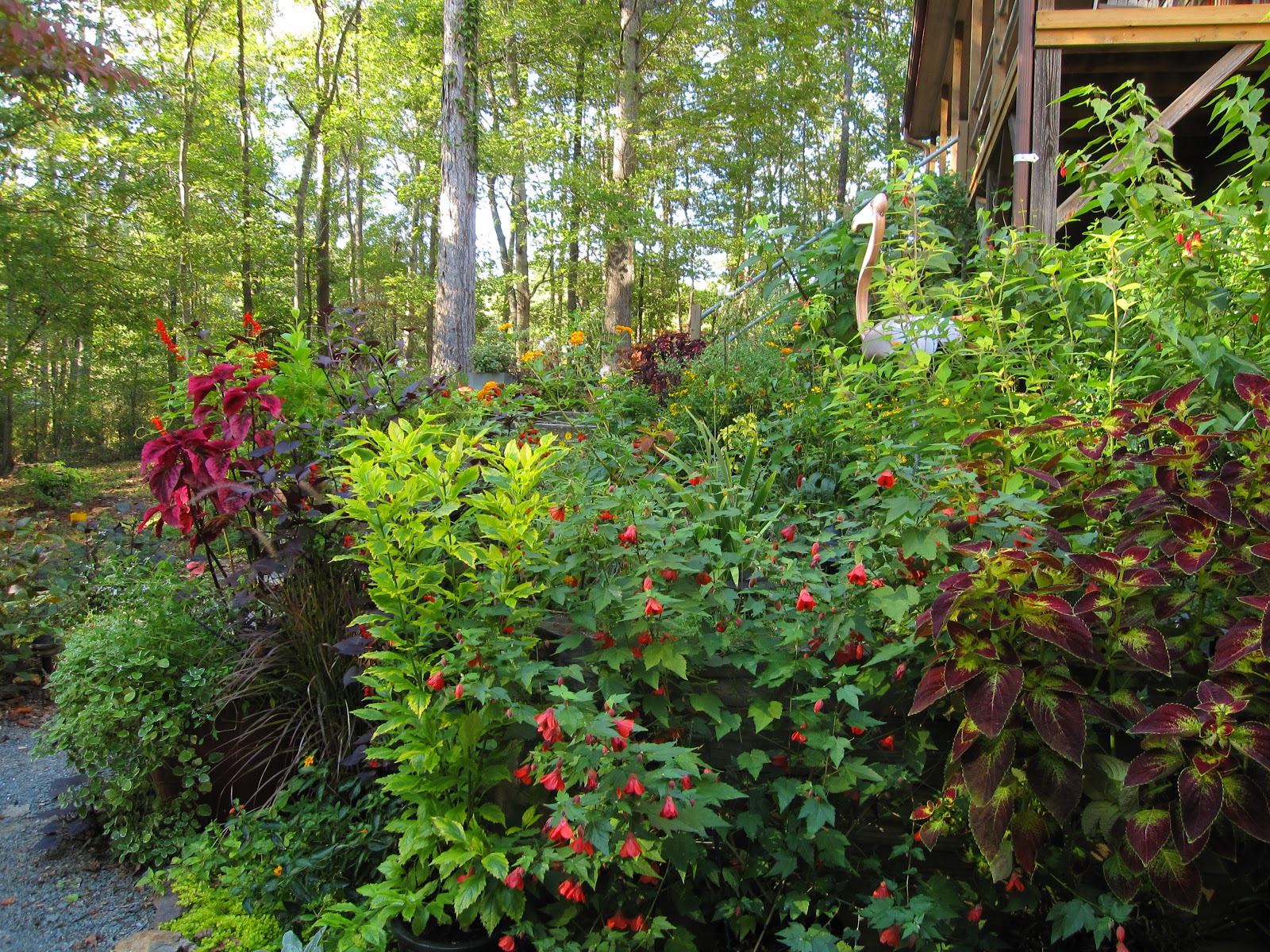
My main flowerbed is spilling beyond its bounds. Plants self-seed in the gravel and a chocolate vine has leapt from its trellis to wind around the deck railing. My promotional life as an author has been equally organic. I’ve made connections, followed my gut, and planted seeds. Some of those seeds have grown in ways I could never have imagined. For example, when I drove 25 miles to an author reading one icky January night, I wanted only to hear Anne Clinard Barnhill read from her debut, At the Mercy of the Queen. But we chatted after the event, and Anne mentioned she was part of this group called Book Pregnant. Two days later I was invited to join. (I love you, Anne!)

Natural-looking gardens are planned
You can spend an entire Sunday afternoon tying up one clematis, and not a single person notices. But as you systematically work through the bed pruning, staking, weeding, and transplanting, something magical happens, and one day even your Brooklyn-born husband says, “Wow, honey. The garden looks great.” Don’t assume your book baby will hit the shelves at number one and stay there. Debut novels quickly become yesterday’s news. In those all-important first few months, you will see a direct correlation between your Amazon rankings and your promotional push. Six months before you launch, take an evening to create a promotional plan, aka a long to-do list of reasonable goals. You don’t have to aim for Oprah, but the local media will likely love the story of a hometown success.

Established gardens can thrive on neglect
I started my main flowerbed a few years before the manuscript that would become The Unfinished Garden, and it’s still a work in progress (thanks to the voles). But in the months after my book launch, I ignored my garden completely. And everyone—including the UPS guy—remarked that the main bed had never looked better. I had huge, ongoing promotional plans for TUG, but I had to tend and fall in love with novel two, The In-Between Hour. Four months out, I cut the umbilical cord; I stopped actively promoting my first-born. But TUG didn’t die. No, I no longer enjoyed the Amazon rankings of the first two months, but that novel just kept bobbing along, quietly doing its thing. (Above: exhibit number one, last night’s book club.)

Even in severe drought, plants survive
Gardening can be heart breaking. Severe drought and watering restrictions can ruin years of hard work and make you feel it’s all so pointless. But some plants shut down not to die, but to survive. Leave them alone and they’ll come back when they’re ready. Some promotional ideas need to percolate. As with writing, time and distance can be a blessing. Because The Unfinished Garden has an unusual hook—obsessive-compulsive disorder—I wanted to do a fundraiser to benefit the International OCD Foundation, a not-for-profit group that has helped my family battle OCD. But the plans for a fundraiser fell apart. (You can only cram so much into one day.) Last month I learned that the IOCDF was going to publish an article I had submitted to their newsletter years ago. This inspired me to advertise TUG in the IOCDF annual conference brochure. I’m with MIRA, which means I have the power of Harlequin behind me. My lovely publisher produced a beautiful ad—at no cost to me—and I paid for the space. Then my IOCDF contact asked if the conference bookstore could sell The Unfinished Garden. How fabulous is that?

Plant beautiful flowers and the hummingbirds will come
Book club fiction, which is what I write, can be a slow burn. But if you have an unusual hook, if you have a story that lends itself to discussion, readers will find you. I started by emailing friends to ask if they knew of any neighborhood book clubs, and things grew from there. (Nine months out from my launch, I just visited three more local book clubs.)

Quitting is never an option
Yes, you can have a grand plan for an award-winning garden, but so much of gardening is beyond your control. A true gardener is a master of resilience. A true gardener never gives up, never surrenders. A true gardener knows that despite the plague of white fly, despite the fifth day of 100 degrees, despite the large tree limb that flattened the mature hydrangea, there is no quitting.

As British horticulturalist Gertrude Jekyll said, “The love of gardening is a seed that once sown never dies.” Does that sound familiar, my writer friends?

______________________________________________________________________

Barbara Claypole White is the author of The Unfinished Garden  a love story about grief, OCD, and dirt (Harlequin MIRA, August 2012)

*Finalist, 2013 Golden Quill Contest, best first book

*Finalist, 2013 Write Touch Readers' Award Contest, mainstream with romantic elements

*Finalist, 2013 New England Readers' Choice Beanpot Award, mainstream with romantic elements


Thursday, 7 March 2013

How To Be Your Own Publicist

By Barbara Claypole White

Press coverage is the frosting on your book launch and probably the only promotional activity you’ll engage in that’s free. Yes, FREE.

Author loops have endless chatter about hiring publicists, but really, you can do it yourself. Good press coverage depends on two things: research and crafting a story. And who better to do either than a writer?

As a former publicist, I created a marketing plan—okay, a glorified to-do list—with big dreams of national press coverage. But like most debut authors, I had limited time and resources. So, I focused on what I could handle—contacting the local press. And it paid off big time.


Local media is a huge resource for the following:
- news coverage of author events and book releases
- features /  interviews  with authors
- author event listings 
- book reviews 
- event photos—if it’s a slow news day

Step one: communicate with your publisher 
My publisher seemed happy for me to contact the local press, but I kept them in the loop. This was how I discovered that one of the lovely guys in the P.R. department could coach me through a radio interview. You’d think I’d know how to talk to the press, right? Wrong. I knew how to promote other people’s work, not my own. My debut novel, The Unfinished Garden, is a personal story on many levels. When I talk about it, I get sentimental and sidetracked. Not good.


Step two: do your homework
Research your local media the same way you researched agents. Decide who you want to approach and why. For example, I contacted the editor of Triangle Gardener, a free magazine with a long shelf life and a good circulation. She told me politely that the magazine didn’t cover fiction, but I had perfected my pitch. I mentioned how my novel had an interesting twist on the theme of the healing power of gardening. Because I’d done my homework, I also knew that a blurb about the book—with a picture of my pretty cover—would be a good fit on their “News for the Garden” page. As you can see above, it was.

Step three: figure out lead times
Common sense here, but obviously a local weekly with event listings has a shorter lead time that a glossy magazine that comes out once every two months.  Know thy lead times.

Step four: lists are important
Create lists of news journalists, feature writers, community calendar editors, book reviewers, photo editors, and local organizations with newsletters. You can contact all of them for slightly different things. For example, someone compiling a listing of local events will want only the most basic information: time, date, place, event. If you’re interested in news coverage or a feature, you will need to…

Step five: find your hooks
Figure out what makes your novel different or newsworthy. For example, I worked several different angles for The Unfinished Garden:
  1. Local settings. My heroine owns a wholesale plant nursery in Orange County, North Carolina, where I live. For my inaugural signing, I chose to read from an important scene set at a local hot spot, the Maple View Farm Country Store. The county press loved this angle, as did a preserve-our-countryside group that publicized the event in their newsletter.
  2. Local girl makes good. My heroine, who’s English, rushes back home to her childhood village after her widowed mother has a nasty accident involving a springer spaniel and a hedgehog. At one point, she visits the historic market town of Olney, near the village where I grew up. This was the angle I worked for the local press in England. In addition, I donated ten signed copies to the Olney Oxfam Bookshop, a charity store that’s mentioned in the novel—another angle that attracted the local press. (The shop also promoted TUG heavily on their Facebook page.)
  3. Gardening as therapy. We have serious gardeners in my area. No brainer.
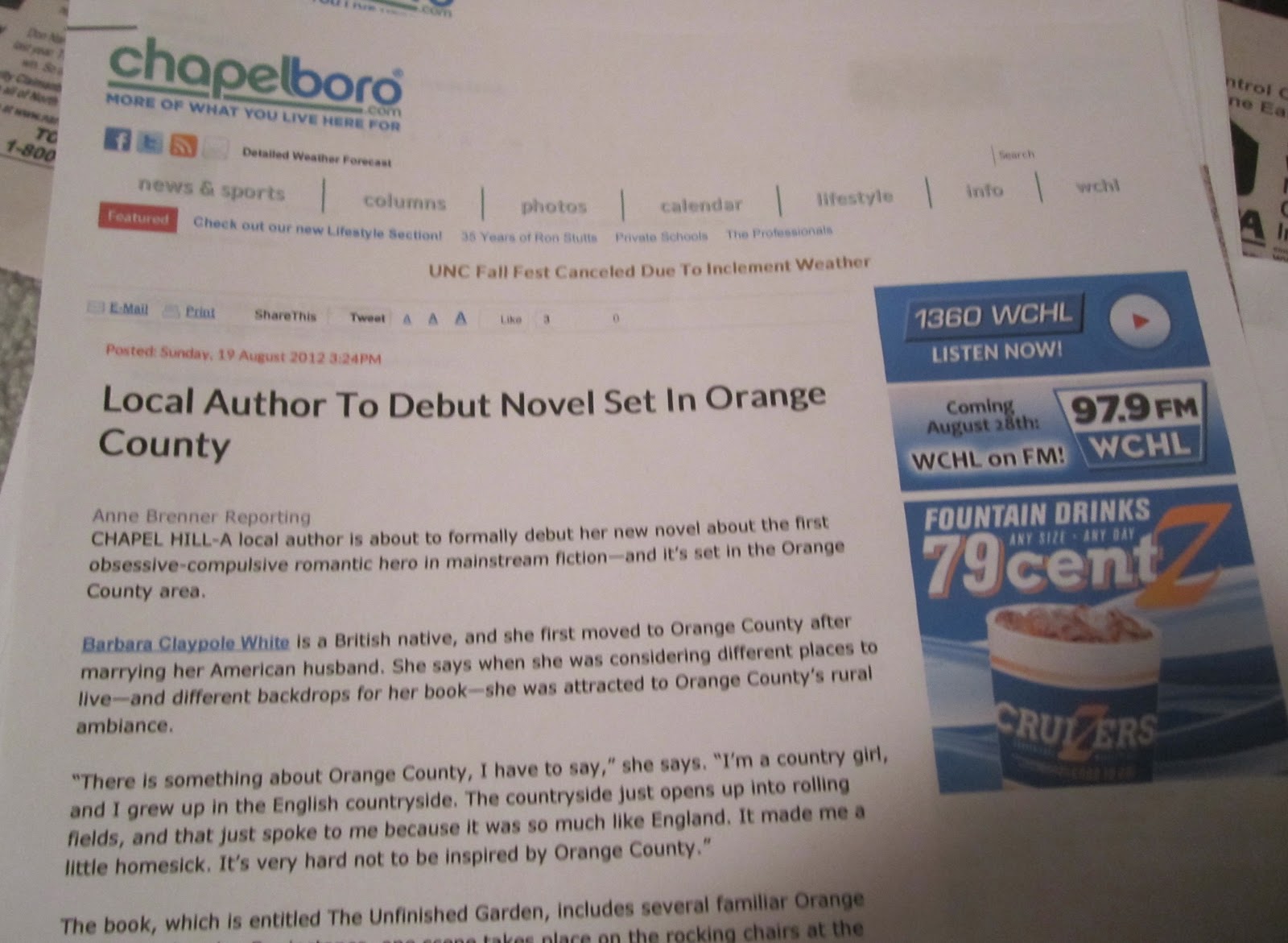
  4. OCD is an unusual hook for fiction. OCD frames my world as a mother and as a writer of fiction and non-fiction. The hero of TUG is the first obsessive-compulsive romantic hero in mainstream fiction, and he's a believable obsessive-compulsive. Since myths, stigma, and stereotypes surround OCD, this makes him unusual. I used this angle to set up an event at the local library during OCD Awareness Week and to snag two radio interviews. Oh, and the success of Silver Linings Playbook has presented new opportunities. (The fun never ends with P.R.)
Step six: first contact
Press releases are useful, but I’m not a fan. Back in the day, when I had big dude clients, the best stories I placed were tailor-made for the media I approached. I know it’s time consuming, but I wrote individualized emails (consider step two). If you opt for a press release, research layout and keep content factual and concise. You have one goal: sell your story.

Step seven: follow up
Journalists are just as busy as we are. Don’t assume no answer means lack of interest. The most impressive coverage I received came from my local paper. I had emailed the editor several times, and she hadn’t answered. One day, on a whim, I phoned. She was so apologetic, said she’d meant to answer me but had been swamped. As we chatted, we discovered she lived down the road. After she stopped by one night on the way home from work, we spent several hours together. She did an in-depth interview, took photos of my garden, and left with a signed copy of TUG. Several weeks later, she posted a glowing review online, wrote a full-page article about me and the novel, and wrote a second article about OCD. I call that the motherload.

Step eight: preparing for interviews
Create five or six key points and aim to control the interview by inserting one key point into every answer you give. Here are my key points:

  • The Unfinished Garden is a love story about grief, OCD, and dirt 
  • It’s published by MIRA, the imprint of Harlequin that handles mainstream or literary commercial fiction 
  • Readers can find me on Facebook 
  • Readers can check out my website, barbaraclaypolewhite.com, for listings of my events
  • TUG is available as a trade paperback and an e-book from Amazon, IndieBound, Barnes & Noble, Books-A-Million, the Harlequin website, and iTunes, and signed copies can be ordered through Flyleaf Books in Chapel Hill (my local indie)
  • OCD is a highly individualized anxiety disorder that creates irrational fear in the absence of true threat. In its most severe form, it’s a crippling allergy to life. (Personal aside: Real OCD is a living, breathing nightmare. To fight back, as my beloved hero does, takes extraordinary courage. This is a point I wanted to make in every interview)

Step nine: send thank yous
Remember—you’re going to need these people for novel two!

Step ten: don’t stress
Any press coverage you orchestrate will help spread the world. If you only manage to contact one local media outlet, that’s still huge. Be proud, be very proud. And then return to what you do best: writing.

__________________________________


Barbara Claypole White is the author of The Unfinished Garden, a love story about grief, OCD, and dirt (Harlequin MIRA, 2012)
“White…conveys the condition of OCD, and how it creates havoc in one’s life and the lives of loved ones, with style and grace, never underplaying the seriousness of the disorder.” Romantic Times 4* review
“Barbara Claypole White gives us a moving story about the challenges of OCD and grief combined with the power of the human spirit to find love in the most unlikely of places.” Eye on Romance
“A fabulous debut novel, The Unfinished Garden easily earns Romance Junkies’ highest rating of five blue ribbons and a recommended status for its unpredictable originality! So good!” Romance Junkies


Thursday, 14 February 2013

Writing Love


Those of us who write about love face a new dilemma. According to the 2013 judging guidelines for the Oscars of the romance writing industry, the RITAs and the Golden Hearts, the romance of a story is now twice as important as plot, character, and writing.

Where does that leave women’s fiction writers who cross over into the category of novels with strong romantic elements? Confused and struggling to define ourselves. Women’s fiction may be a shape shifter, but tell us romance is the most important part of our novels, and we're likely to give you the evil eye.

As publication day loomed, I was terrified that my book baby would be shelved under romance. Relationship stories, which are my thing, have always fallen between the thinnest of cracks. To complicate the definition, my characters find hope and love in the darkness of mental illness. Think Silver Linings Playbook with woodland garden settings.

The Unfinished Garden—TUG—sold to MIRA, an imprint of Harlequin, as women’s fiction. Despite various incarnations, it has always been the story of Tilly, a young widow whose grief has begun to twist into relentless guilt. Enter James, a charismatic, brilliant obsessive-compulsive who recognizes that Tilly is trapped in the world of obsessive thought. TUG is Tilly’s journey because of James. Without James—no life-altering epiphany for Tilly.

Before publication, I adopted the mantra, “It’s a love story, not a romance.” Then TUG launched—as an August romance pick at Barnes & Noble. My worst fear was realized: My debut novel was destined to be labeled romance.

I told myself it didn’t matter, but I was faking. Until I read my first romance novel and had my own HEA—happily ever after—moment. I consumed that novel in one weekend. “Go away,” I told the family. “I’m working.” And I was, because I was learning how the pros craft page-turning love scenes. It was like binging on English candy, which I do every summer within 24 hours of returning to England. (I miss wine gums something rotten.)

There’s no sex in TUG, there’s only one kiss, and because my hero is phobic about soil and my heroine is a gardener, it takes him a while to hold her hand. But from the moment they meet, Tilly and James have sexual chemistry. Their mutual attraction does not define the story even though it does help drive the plot. For at least one chapter, they’re on different continents. Tilly is wading through heavy-duty family drama, and James doesn’t enter her mind. In the romance novel I was reading, however, the sexual tension was up front and center on every single page. I was awestruck.

I learned something else, too: this romance writer was a master in the art of pacing, and boy, had I been struggling with pacing in novel two. After finishing her novel, I ripped apart my first nine chapters, which had been filled with introspection, backstory, and lovely descriptions of the North Carolina forest. “Back to the story,” I kept muttering.

The one complaint I had with this romance novel was the writing. It was littered with coursing and throbbing. But then again, I’ve read mainstream novels chock-full of chuckling. (Chuckle is my trigger verb. I detest it.) Writing is super important to me. I agonize over sentences and word choice. When I read Jodi Picout—whom I think of as the queen of women’s fiction, although she’s a genre bender—I am constantly collecting sentences that scream, “This is how you do it!”

So. Am I going to morph into a genre romance writer? No. But six months out from pub date, I have a new mantra: “I am one with the romance label.”  Hand on heart, I no longer care how readers classify TUG—provided they enjoy the story.  Much of my life echoes through my first book baby. I thought I knew every theme and every thread, but then it bounced out into the world and surprised me.

Two weeks ago, I had the biggest surprise of all.  Simply Books, the Harlequin Reader Service magazine, declared TUG number one in their list of Most Romantic Books of 2012. Tilly and James had even earned a rosy pink heart for being sensual. I was thrilled. I celebrated by toasting my favorite couple with Bombay Sapphire gin. And I’m pretty sure they approved.


Barbara Claypole White is the author of The Unfinished Garden (Harlequin MIRA, 2012), a love story about grief, OCD, and dirt. You can find her on Facebook.

“White…conveys the condition of OCD, and how it creates havoc in one’s life and the lives of loved ones, with style and grace, never underplaying the seriousness of the disorder.” Romantic Times 4* review


“Barbara Claypole White gives us a moving story about the challenges of OCD and grief combined with the power of the human spirit to find love in the most unlikely of places.” Eye on Romance.


“A fabulous debut novel, THE UNFINISHED GARDEN easily earns Romance Junkies’ highest rating of five blue ribbons and a recommended status for its unpredictable originality! So good!” Romance Junkies