Showing posts with label SlightlyFoxed. Show all posts

Monday, 10 December 2012

A Cab at the Door - V.S. Pritchett

photo source
More Slightly Foxed!  Yay!  Well, this one was actually a little bonus - earlier in the year, when they sent me the fabulous Look Back With Love by Dodie Smith, they inadvertently sent me A Cab at the Door by V.S. Pritchett first.  And then very kindly said I could have both.  Having recently adored Blue Remembered Hills, I realised I couldn't go long without another fix of Slightly Foxed, and so grabbed A Cab at the Door (1968).

I have to confess, I've spent much of my adult life confusing V.S. Pritchett and V.S. Naipaul (he of the I'm-better-than-all-women rant).  As crimes go, it's not the worst, and I hadn't actually read anything by either of them - but now I'm sure that Pritchett is going to be my favourite V.S.  Sorry, Italian astronomer V.S. Casulli.  Tough break.

Like all the Slightly Foxed Editions (of which this is no.3), A Cab at the Door is a memoir - stretching further than some, in that it takes us beyond childhood, up until the time Pritchett breaks away from his parents and leaves home for France.  Like most memoirists, Pritchett seems to have been blessed with more amusing, regional relatives than the average person (c'mon, my relatives, be more comical) but although we have entertaining visits to these, the dominant character in this memoir is Pritchett's father.  And I choose the word dominant deliberately.  Whatever other merits the book has, I think its greatest achievement is a rich and complex portrait of the sort of man who would simply appear as an ogre in fiction.

Father (if his name is mentioned, I have forgotten it - as I invariably forget names) is selfish, arrogant, and angry.  His cruelty is that peculiar brand which stems from monumental self-delusion - he drives his family deeply into debt, but appears to believe it is none of his doing.  He has constant ambition to better himself and his standing in society (and even achieves it to a degree, eventually, becoming a Managing Director) but doesn't care how his failures along the way ruin and sadden his wife and children.  His wife - a lively and somewhat crude woman - is all but forbidden from entertaining, and is constantly carted from pillar to post, as they move to escape his debts.  The eponymous cab at the door is Pritchett's familiar childhood sight, waiting to take them to their next home.

But because this is non-fiction, Father is not the caricatured evil man, nor his wife the stereotypical woman whose character is squashed out of her.  Instead, despite his unkindness to his younger son, and his unpredictable behaviour towards Victor himself, there is still love in him.  His wife still has moments of shrieking with laughter; Victor can still bond with his father over literature, occasionally, even if his own early attempts at writing are loudly derided.  And what novelist would have the masterstroke of making Father become a fierce proponent of Christian Science?  It is a truly exceptional portrait of a complicated man - and a portrait which is never finished to the artist's satisfaction, simply because he could not be comprehended.  Pritchett writes this brilliant paragraph towards the end:
Right up to the day of his death in his eighties, none of us children could settle our view of him.  It was simple to call him the late Victorian dominant male without whose orders no one could think or move.  It was only partly true that he was a romantic procrastinator, egotist and dreamer, for he was a very calculating man.  Sometimes we saw him as the unchanged country boy, given to local shrewdness and gossip.  (He loved the malicious gossip of his church and his trade.)  Sometimes we saw him as a pocket Napoleon, but he never even tried to obtain the wealth or power he often talked about.  His mind was more critical than creative and he was appalled by criticism of himself.  He would go pale, hold up his hand and say, "You must not criticise me."  He sincerely meant he was beyond criticism and felt in himself a sort of sacredness.
A Cab at the Door doesn't have the warmth and delight of other Slightly Foxed books - it doesn't intend to - and so, while Pritchett cannot compete with Dodie Smith and Rosemary Sutcliff for my affections, his task is different and executed incredibly well.

There are, of course, other angles and facets to this memoir, but I thought it worth identifying and discussing the one which set it apart from others that I have read.  Perhaps not one to curl up with in front of the festive log fire (for that, get Look Back With Love or Blue Remembered Hills, I cannot encourage you enough) but certainly an impressive portrait of a frustrating man, exactly the right ratio of objective and personal, an exemplary achievement.

Monday, 12 November 2012

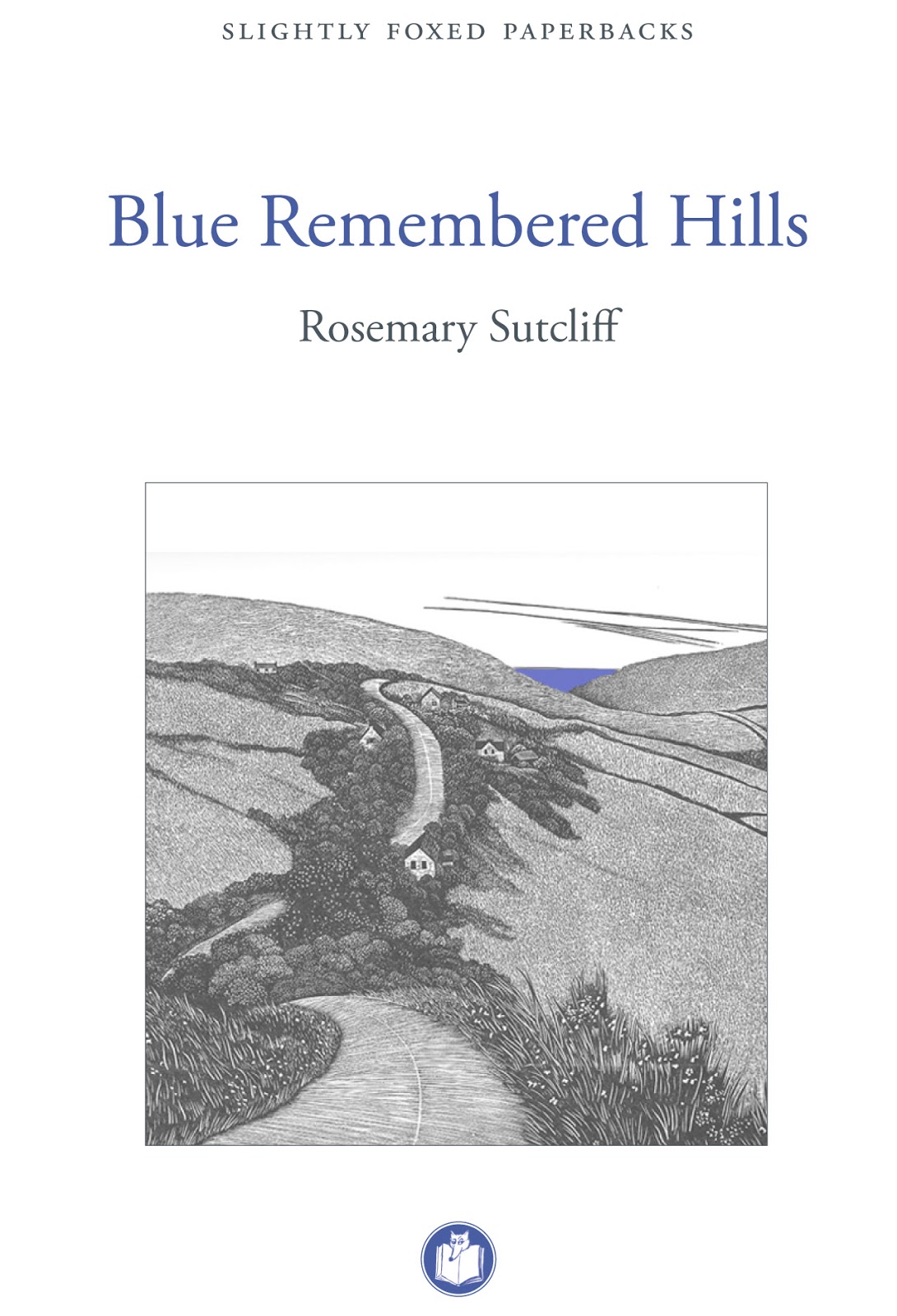
Blue Remembered Hills - Rosemary Sutcliff


There must have been a time - a dark, bleak time - before I was introduced to the Slightly Foxed Editions.  I love the Slightly Foxed journal when I get my hands on a copy, but that doesn't compare to the bottomless affection I have for all the memoirs I've read in their Slightly Foxed Editions series.  Which is, I realise, only five or six - I still have a long way to go.  But the one I finished recently is battling it out with Dodie Smith's Look Back With Love not only for my favourite SF, but for my second favourite book read this year (Guard Your Daughters has secured first place.)

I need to start condensing my preambles, don't I?  The book is Blue Remembered Hills (1983) by Rosemary Sutcliff, and it is heartwarmingly wonderful.  The original run of 2000 hardback copies has sold out and, due to its popularity, Slightly Foxed have produced this paperback edition.  Unlike most of the people I've spoken to about this book, I've never read anything by Rosemary Sutcliff.  My allergy to historical fiction has been lifelong, and her Eagle of the Ninth series has never got nearer than the peripheries of my awareness.  That doesn't matter in the slightest, in terms of enjoying this book, believe me.

Born in 1920, Sutcliff was quite isolated in her childhood - she was an only child, and (after suffering Still's Disease when very young) had varying levels of disability, and spent a great deal of time in and out of hospitals and nursing homes.  Yet this couldn't be further from a misery memoir.  Everything is coated with a fascination for life, and a joy for the possibilities of observing and experiencing.

Like Smith's childhood memoir, Sutcliff has great fun describing all her relatives - how blessed these memoirists seem to have been with comic uncles and aunts! - and especially her parents.  Her mother seems to have had undiagnosed bipolar disorder - Sutcliff describes times when her mood would change for days without warning - and this understandably made her unpredictable to live with.  This was coupled with a difficult personality, and Sutcliff (though generous to her) clearly didn't have an entirely easy mother/daughter relationship.  Her father (a sailor) spent long periods away from home - all in all, not a simple childhood for young Rosemary.

But, as I say, she finds the beauty and joy in this all - not by ignoring her difficulties, but by maintaining an optimistic attitude.  Indeed, it wasn't until I sat back and put together the information Sutcliff gives about her parents that I realised the difficulties she faced.  In Blue Remembered Hills this sort of excerpt represents the tone with which Sutcliff recalls them:
He was a lieutenant when he and my mother were married.  The had first met when they were both fourteen, at a mixed hockey match, and he always claimed that the first word he ever heard her say was 'Damn', which I suppose, to judge from her vehemence in protesting that it was the first time she had ever said it, was quite a word in those days.  My father's invariable retort - oh, the lovely ritual changlessness of family hokes and traditions! - was that for a first time, she said it with remarkable fluency.
I think my favourite thing about childhood memoirs is the revelation of family jokes.  It makes the reader feel, at least for a page or two, that they've been inducted into the family.  We all have these, don't we?  And they're usually senseless and silly, and oh so precious!

Among Sutcliff's many memories, the ones which most warmed my heart were about Miss Beck's school.  Education reform has doubtless done much for children's welfare, but as a side-effect it was removed the possibility of anything as joyful as this:
In a small back room with peeling wallpaper, under the eye of a gaunt elderly maid, I was stripped of my coat, leggings and tam-o'-shanter, in company with twelve or fourteen others of my kind.  And with them, all on my own, so grown up, I filed through into the schoolroom, to be receive, as Royalty receives, by Miss Beck herself, who sat, upright as Royalty sits, in a heavily carved Victorian armchair.

My schooldays proper had begun.

Looking back with warm affection at that first school of mine, I can hardly believe that it was real, and not something dreamed up out of the pages of Cranford or Quality Street.  I suppose nowadays it would not be allowed to exist at all.  Miss Amelia Beck had no teaching qualifications whatsoever, save the qualifications of long experience and love.  She was the daughter of a colonel of Marines, in her eighty-sixth year when I became one of her pupils; and for more than sixty years, in her narrow house overlooking the Lines at Chatham, she had taught the children of the dockyard and the barracks.  She accepted only the children of service families.  Oh, the gentle snobbery of a bygone age; bygone even then, and having less to do with class than totem.  It was her frequent boast that she had smacked, in their early days, most of the senior officers of both services.  Both, not all three, for the RAF was too young as yet to count for much in Miss Beck's scheme of things.  But I do not think that it can have been true, unless she had gentled greatly with the passing of her years.  For I never knew her to smack anybody during the year that I sat at her feet.
Isn't that blissful?  There is quite a bit about this school and Miss Beck, who stayed in touch with every pupil she taught (or so Sutcliff claims!) - it is all fairly ordinary, but made extraordinary through Sutcliff's lovely writing and engaging personality.

In fact, it is the ordinariness of Sutcliff's life that makes Blue Remembered Hills so difficult to write about.  It is oddly similar to The Outward Room, reviewed yesterday, in being significant not for its incidents, but for the beautiful way in which they are related.  After relaying the activities, thoughts, people and pets of her childhood, Sutcliff relays her early career as a miniaturist (not, she notes sadly, a form likely to win any major notice in the art world) and her first infatuation.  Those are the two important strands in the second half of the book, I suppose, and it continues up to her first literary commissions.  But the events are so much less vital than the tone.

So, yes, it's another book you have to read to appreciate... but, oh, what a warm, engaging, beautiful book it is.  One of the very few where I cannot bear the lessening pages as I read on - and which I am certain I shall return to time and again.  Slightly Foxed - I don't know how you do it.  You are my new addiction.  Long may you continue to find memoirs as spectacularly lovely as this!


Others who got Stuck into this:

"Perfect. My only complaint is that it is too short." - Leaves and Pages

"The tone of the book is one of gratitude for life’s blessings & joy at the natural world, her friends, her dogs & her love for her parents." - Lyn, I Prefer Reading


Wednesday, 22 February 2012

Look Back With Love - Dodie Smith

I am growing very fond of those lovely folk at Slightly Foxed.  Last December I had spotted that they were publishing Dodie Smith's first autobiography, Look Back With Love (1974), and was umming and ahhhing about asking for a review copy... when they offered me one!  Although I'm always flattered to be offered books by any publisher, my heart does a little jump for joy (medically sound, no?) when it's a reprint publisher doing the offering.  And even more so when it's one of these beautiful little Slightly Foxed Editions (I covet the *lot*) - and even more so when it's a title I've wanted to read ever since I first read and loved I Capture the Castle back in 2003.


I was not disappointed.  Look Back With Love is simply a lovely, warming, absorbing book.  It is only the possibility that I may prefer one of her other three autobiographical instalments (think of it; three!) which prevents me adding it to my 50 Books You Must Read list just yet...

You may have gathered from all those volumes of autobiography that Smith doesn't cover her whole life in Look Back With Love.  Indeed, she only gets as far as fourteen by the end of this book, placing it firmly in childhood memoir territory.  I do have a definite fondness for memoirs which focus on, or at least include, childhood - as evinced by my championing of Emma Smith's The Great Western Beach, Angelica Garnett's Deceived With Kindness, Harriet Devine's Being George Devine's Daughter, Terence Frisby's Kisses on a Postcard, Christopher Milne's The Enchanted Places, and one of Slightly Foxed's other recent titles, P.Y. Betts' People Who Say Goodbye.  I especially like them if they cover the Edwardian period - perhaps because that means the subjects will have been adults in the interwar period which I love so dearly.  What links all these autobiographies, besides their recountings of childhood, is that they recount happy childhoods.  That is to say, they all find and express happy moments from within their childhoods, rather than prioritising the miserable or cruel.  Misery memoirs, I'm afraid, will never have a place on my bookcases.  I can understand why people write them - it must be a form of catharsis - but I cannot begin to fathom why people want to read them.

Dodie Smith's family sounds like it was wonderfully fun.  True, her father died in her early childhood, and she was an only child, but these sad circumstances do not seem to have held her back.  She certainly didn't grow up isolated: her widowed mother moved back to her parents' house, and so Dodie grew up surrounded by grandparents, aunts, and uncles.  The aunts gradually married and moved, but three uncles remained bachelors and meant (Smith says) that she never felt the absence of a father.  The dynamics of the family certainly don't seem to be lacking much.  As the only child amidst so many adults, Smith was showered with affection and approval - and no small amount of teasing...
Somehow I knew I must never resent teasing and though I sometimes kicked my uncles' shins in impotent rage, never, never did it make me cry.  Teasing must be accepted as fun.  And I now see it as one of the great blessings bestowed on me by those three uncles whom, even when they became elderly men, I still referred to as 'the boys'.
Smith's autobiography is not a string of momentous occasions, really, but a continuous, welcoming stream of memory.  Of course there are individual anecdotes, but the overall impression I got was of a childhood gradually being unveiled before us, with stories and impressions threaded subtly into what feels like a complete picture.  I was mostly struck by how accurate Smith's memory seems to be:
All the memories I have so far described are crystal clear in my mind; I see them almost like scenes on the stage, each one lit by its own particular light: sunlight, twilight, flickering firelight, charmless gaslight or the, to me, dramatic light of a carried taper.
This particular comment is actually an apology for the fact that, for recollections before she turned seven, Smith cannot recall exact chronology.  Well!  I have come to realise that my own memory is rather shoddy.  I remember strikingly little about my childhood - or, indeed, about any of my past.  If family and friends talk about an event, there's a good 50/50 chance that it'll come back to me - but if I were to sit down and try to write an autobiography, I think I'd come unstuck on about p.5.  I just can't remember very much, at least not without prompts.  Curious.  But it makes me all the more impressed when writers like Smith seem effortlessly to delve into their past and convey it so wonderfully - especially since Smith was in her late 70s when she wrote this memoir.

With memoirs, I seem especially drawn to people (like Harriet Devine) who grew up amongst theatrical folk, people (like Irene Vanbrugh) who became actors, or (like Felicity Kendal) both.  There's always been a part of me that wishes I'd grown up alongside actors and theatre managers.  Although I have no genuine aspirations to be an actor, I'm endlessly fascinated by the world of the stage, especially before 1950.  Well, although Smith's relatives were not connected with the theatre professionally, several were keen amateurs, and some of my many delights in Look Back With Love were Smith's first adventures upon the stage - especially the ad-libbing.

These sections were all the more enjoyable because Smith made frequent reference to her later career as a playwright.  (I've only read one of her plays - her first, published under a pseudonym - but am now keen to read more.)  When I wrote about P.Y. Betts' People Who Say Goodbye I commented that it was as though her childhood had been hermetically sealed.  Not once did she introduce her later life, or make links across the decades.  This worked fine for me, since I'd never heard of Betts before, and was happy to take her memoir on her terms.  Since I came to Look Back With Love with an extant interest in Dodie Smith, I've have been disgruntled if she hadn't made these connections between stages in her life (although, tchuh, she didn't mention I Capture the Castle.)

I keep saying that different things from this book were my favourite part... well, that's because I loved so much of it.  But I think, honestly and truly, my favourite element was Smith's ability to write about houses.  I love houses.  Not just to live in (they're handy for that) but as subjects for novels, autobiographies, TV redecoration programmes...  Chuck me a novel where the house is central, and I'm in.  Write something like Ashcombe and I'm delirious.  So I loved the way Smith conveyed the various houses she lived in.  Not that she wrote in huge detail about decor or style, although these were mentioned - more that, somehow, she manages to make the reader feel as though they were also residents in the houses, looking around each room with the familiarity of those who share Smith's memories.  I can't pinpoint an excerpt which made me feel like this; it permeates the book.

Most of Look Back With Love is (as the title suggests) lit by the glow of nostalgia.  The humour tends to be gentle, intertwined with the fond remembrance of innocent times past, rather than knockabout comedy, but there was one excerpt which made me laugh out loud.  It's part of Smith's tales of schooldays:
My mother felt the elocution lessons were well worth the extra she paid for them, but she was not pleased when Art became an extra, too.  Drawing, plain and simple, was in the curriculum but, after we had been drawing for a year or so, the visiting mistress would bend over one's shoulder and say quietly, "I think, dear, you may now tell your mother you are ready for Shading."  This, said my mother, merely meant she had to pay half a guinea extra for me to smother my clothes with charcoal; but it would have been a bad social error to refuse Shading once one was ready for it, so she gave in.  I then spent a full term on a bunch of grapes - the drawing mistress brought them with her twice and then we had to remember them; they were tiring fast.  After a few terms of Shading pupils were permitted to tell their mothers they were "ready for Oils", but mothers must have been unresponsive for I can recall only one painting pupil.  She had a very small canvas on a very large easel and was generally to be seen staring helplessly at three apples and a Japanese fan.  After many weeks I heard the drawing mistress say to her brightly, "One sometimes finds the best plan is to start all over again."
Lovely, no?

This has gone on for quite long enough, so I'm going to finish off with a characteristic piece of Dodie's writing.  The setting, ladies and gents, is the senior (mark it, senior) dancing class.
There were so many superb boys that I did not see how I could be without a partner, but I was soon to realise that there were two girls too many and I was always one of them.  Few of the boys were younger than fifteen.  I was only nine and small for my age, but I could never understand why they were not interested in me - I felt so very interesting.
This is the rhythm which is maintained throughout Look Back With Love: young Dodie always thought she was very interesting, and old Dodie looks back across the years with the same level of interest, albeit now more detached.  There is every possibility that this level of self-importance in a child would have been irritating for those around her - Smith freely confesses that she used to recite and perform at the merest suggestion of the drop of a hat - but, from the adult Smith, it pulls the reader along with the same happy enthusiasm.  Smith's childhood was not wildly unusual, but the way she is able to describe it elevates Look Back With Love above other childhood memoirs.  Everything, everyone, is capable of interesting Dodie Smith (adult and infant), and this makes her the most fascinating subject of all.  It is rare that I am bereft to finish a book.  A mere handful of titles have had this effect on me in the past five years.  But Look Back With Love is one - as I turned the final page, I longed for more; I longed to know why she made such dark hints about her stepfather; how her playwriting took off; how she experienced the theatre of the 1930s... thank goodness there are three more volumes to read!


Others who got Stuck into this Book:

Well, I was going to do a round-up of other bloggers who've written about Look Back With Love, but I can only find one who has!  But they say it's quality not quantity, and you couldn't do better than Elaine's review over on Random Jottings:  "Look back with Love is a lovely, lovely, lovely book.  It is charming, it is delightful, it is beguiling, it made me laugh and it made me cry and I adored every single word of it and was very sad to finish it. [...]"