Showing posts with label third trimester. Show all posts

Wednesday, 24 April 2013

Bragging About Your Child—Real or Book—Is No Way to Win Friends or Influence People

by Sophie Perinot


You see them in every playgroup—parents who aren’t really interested in the give and take of meaningful conversation. Instead, while Johnny eats dirt in the sandbox, they want to monologue about just how great he is. No matter the topic under discussion, they turn it in the same direction: “MY son. . .” (fill in the blank with a brag of your choice, often only very tangentially related to the subject at hand). Nobody likes these people. Nobody enjoys talking to them. Why then, I wonder, do so many authors model their social media interactions on these bores?

I’ve noticed quite a bit of this sort of blind self-centeredness lately, particularly in writing and reading related facebook groups. When I join a group devoted to say “Lovers of Mysteries with Dogs as Their Main Character” (okay I made that one up, but I don’t want to point fingers at actual groups or communities), I expect folks therein to share information on good books with doggy detectives, or links to websites to help me in researching or writing such tomes. Instead, what I am getting these days are nearly naked brag-ver-tisements—“My book ‘It’s a Dog Eat Dog World’ just got a super-duper review at ‘Dog books R us!’ Read it here. Or better still buy my book here, or here, or here.”

Come on fellow book-parents, if I want advertisements there are plenty running along the top or side of every darn website I visit. You’ve got a personal facebook page, probably an author FB page, and doubtless an author website where you can share good reviews and “buy it now” links. You can even directly and unabashedly promote your book at those locations (though the jury is out on how effective that will be for you). But the essence of communities/groups (even in the virtual world) is dialogue.

A hybrid of “boast posters” are the folks who share EVERY blog post they’ve ever written or will ever write to a facebook group, irrespective of whether it’s on topic. Sure, if you (or if I) have written a post that is germane to the topic of a group or comment thread (or touches on one of the subjects that you assume people follow you on twitter to hear about) then posting your link is a worthy public service. But if you are turning every conversation in the direction of yourself or your book-baby then spare us and save yourself the time (because pretty soon I for one am going to stop even looking at your posts because I already KNOW what they will say—some version of “my baby is so great.”)

As writers today there is a great deal of pressure on us to market our own work, and very specifically to have a presence in the virtual world. But I presume that an annoying presence seldom sells a book. If you join a community of like-minded people as part of your “building an internet presence” campaign, please try to interact with fellow members in a genuine, non-agenda-driven, manner. And for the record an interaction is neither effective nor genuine when it amounts to commenting on topics started by others about their book-babies PURELY for the purpose of turning attention to yours (“Oh Missy looks great in her tutu, but did I ever tell you about the time Mary did a guest appearance with the Rockettes?  Here’s the video link!”).

People can smell a pushy mama a mile away—whether in a school auditorium or on twitter.  If you are only talking and not listening in your on-line relationships you are wasting your time. People are going to start moving their chairs away. Want to get something out of your on-line-community participation?  Put something in.  How?  I can suggest two concrete ways:

Be a friend, make a friend. When another mom asks a favor of me in real life (e.g. can you pick up my kid tomorrow I have to go to the dentist) I am WAY more likely to go out of my way if I genuinely like that her and have a sense that she’d have my back if I was in pinch.  So in your author interactions build meaningful connections.  Listen to what other virtual community members have to say and comment intelligently.  Make friends rather than trying to score sales.  You may just get the sales to boot, because I buy books written by friends (folks I’ve gotten to know through writers conferences, through on-line communities and through their blogs), don’t you?

Gain influence by offering information and expertise.  I write historical fiction.  That means I know what other history nuts like.  When I read an article that makes me say “oh wow” (most recently an article having do with research on Roman toilets—to each her own eh?) I think, “who else would like to see this,” then I share it accordingly in the correct facebook group or using the appropriate twitter hash tag.  In addition, I take the time to comment, share experiences, or answer questions where my personal knowledge might assist someone else. A question about the difference between a Spanish and a French Farthingale?—I’ve got that.  A fellow writer wondering whether writers conferences are worth attending—I’ve got an opinion on that as well.  Be useful and before you know it you’ve built a “value niche” in the virtual world.  Can that help your book-baby?  I think so.  After all if I know that author X consistently exhibits an impressive knowledge of 18th century Italy, I am more likely to buy her historical thriller set in 18th century Rome.

And hey, think of it this way. . .even if being a full-fledged contributing member of an author playgroup doesn’t demonstratively increase your sales, at least people won’t wince when you pull up your lawn chair next to the monkey bars.


Sophie Perinot is the author of The Sister Queens(NAL/Penguin, March 2012) a novel of sisterhood set in the 13th century. Her debut was widely well-reviewed and made a number of “best of 2012” lists.

When Sophie is not chauffeuring one of her three kids or lint rolling the hair of one of her three cats she is hard at work on a new novel novel set in 16th century France. 

Friday, 1 March 2013

Get out! Get out!


by Sam Thomas

Most writers are pretty insecure about their craft. The insecurity is born of experience: we have seen our work rejected many more times than its been embraced, whether by agents or publishers. We are regularly tell ourselves (or are told by agents or editors) that our work is not good enough. We also tend to keep to ourselves – writing is self-expression for introverts. We did not start bands, take up stand-up comedy, or spend our evenings at poetry slams. We shut ourselves off from the world and wrote.

Fine and dandy, except that with the decline of marketing budgets and the virtual disappearance of literary taste-makers (except the one whose name starts with “O”), the whole J.D. Salinger approach to publicity is not going to fly. Want to get our books out there? It’s up to us. The problem, of course, is that we are insecure and introverted.

My goal here is to encourage new writers to get out there and meet people. Offer to present at local libraries, visit with book clubs, talk to whomever will listen!

If you do, you’ll discover some pretty awesome things. First, it’s a ton of fun. You are already passionate about your work, or else you wouldn’t have taken the trouble to write a book. That passion willcome through. And remember that (unless you’ve set up a kiosk on a street corner), the people who come to see you are already interested in your work, or else they’d be somewhere else. You don’t have to convince them of anything. If you are polite and honest, people will walk away happy.

The other thing to keep in mind is that while you may not think it’s a big deal getting published, and you recognize that it’s a real grind, but others are much more excited. And while it’s pretty clear to you that you’ve been very lucky (at least that’s the case for me), that doesn’t mean you don’t have a good story to tell. People like to hear about the writing and publishing process first hand. The process might grind you down, but talking with readers and prospective readers will build you up!

So get out there!

Wednesday, 27 February 2013

Older and Wiser--Reflections of a Birthday Girl

by Sophie Perinot

You are only young once.  And you are only a debut novelist once. Time passes—you can’t stop it. But if you are going to get older than you might as well work on the getting wiser thing. I mean wisdom is a MAJOR perk of experience.

I am just one day shy of another birthday and one week shy of my book-baby’s first birthday. So I am working hard to focus on wisdom—especially because it keeps me distracted from the appearance of new gray hairs.

Here are some of my new, wiser, attitudes towards being a published author—a state-of-being that I believe that I understand better today than I did one year ago:

It is NOT about the 2%.  When your book is published there will be some minority of people who just don’t get it. More than that, who just don’t like it. My sense, from scanning the goodreads ratings and reviews of my own book and the books of others, is that your anti-fans will be about 2% of your readers. Are you really going to let 2% make you feel bad about your book, your craft or yourself?  If you are, I can’t help you. Nobody can help you. Remember that old saying “you can’t please all of the people all of the time?” Well TRUE THAT! So focus on the 99% who think your work is solid, or better still on the sub-set at the top of the spectrum who give you great reviews and write you nice notes saying they can’t wait to read your next book. You will be saner.  You will be more productive.

It IS about the moment.  The older you get the more you realize moments are fleeting. The same is true for your book. In its first weeks everybody notices a debut novel. It’s a review here and interview there the attention is dizzying. Were you enjoying it, or were you worrying about your next appearance or deadline?  Don’t feel bad—me too. After nearly 12 months on the market, however, I’ve learned to savor a nice blog review when it comes in, ditto that hour with a book club on a Thursday evening. I’ve also learn to stop anticipating problems. The one’s you worry about in advance never seem to happen and the crises that do arise are going to gut kick you when they happen so why worry in advance?

Everybody feels competent to judge, but ONLY your judgment matters.  Everybody has an opinion on this writer-gig you’ve taken on. They feel entitled to judge whether it was a good idea, how you are handling it, and whether you are succeeding.  This is true in very few other professions. When I practiced law other lawyers might have an opinion on my professional competence, but the grocery checkout lady—not so much. The only thing I’ve ever done that has attracted more unsolicited opinions is parenting. But, like parenting, the bottom line here is that only YOU can know why you make the writing-related decisions you do. Every writer wants the good opinion of somebody, but not the same somebody. Every writer wants to sell books, but the number that feels like “enough” and the auspices under which we’d like those sales to be made (e.g. Tradtional, Indie etc.) vary. Based on what we want out of our book babies we will make different parenting decisions than other writers.  So what?  There is no “one right way.”  Let other’s “tsk tsk” you. You are the book parent here and you will be the one living with the results of your decisions.

Do not covet you neighbor’s ox—or your fellow author’s book tour.  Envy will eat the heart of out you. And to what purpose? Jealousy of a fellow author’s cover will not change the art on yours if you don’t like it. Hating on someone because his publisher sprang for six weeks of coop and yours only paid for two will not improve where your book is shelved. If you are busy thinking about the inequities of life and publishing you will miss the good stuff(see point two on enjoying the moment). It also has a tendency to seep out—leaving you looking bitter and unpleasant. Bitter and unpleasant never made a friend or sold a book.  Of course we are all human. If (or rather when) you must indulge in a moment of envy do it privately—that is what good friends are for. And speaking of friends. . .

You don’t have to have lunch with people you don’t like.  I stopped having lunch with people I didn’t like about a decade ago. I thought, “I am likely half-way through my life why the heck am I wasting time and calories in situations I don’t enjoy?” Book promotion is like that too. If you make yourself engage in promotional activities that you don’t enjoy it will only end in heartburn and disappointment, because if you don’t like to do something chances are it will show in the results. Don’t’ like blogging?  Don’t’ blog. Concentrate on doing those author-ly things you actually enjoy, and you will be making the most efficient use of your promotional time and money—at least that’s my opinion. Oh and ditto with the actual lunch thing. Networking is important in this profession but you don’t have to sit on every panel you are asked to sit on, or have coffee with every fellow writer who asks. You are looking to develop a support group of fellow writers and it is perfectly acceptable to have liking those writers as one of your criteria. Tomorrow on my birthday I will be lunching with two fellow historical fiction writers whose work I respect and who I adore and that is as it should be.

Never stop learning.  Learning is like breathing—if you stop, you die (or at least part of you does).  You can always be a better person and a better writer. Read with your “writer glasses” on. Keep up with the industry. Beg, steal or borrow promotional and motivational ideas from other writers you respect. Listen. Not only to other writing professionals but to readers. I ask every book club I visit where they think I fell down on the job. You don’t have to react to every bit of feedback you receive, it is within each author’s purview to access whether a critique resonates, but if you never entertain the possibility that there is room for improvement you will not improve.

Your whole goal is be wiser next birthday and next book-baby isn’t it?  That sure is my goal, and possibly an appropriate wish as I blow out this year’s candles. 


Sophie Perinot is the author of The Sister Queens (NAL/Penguin, March 2012) a novel of sisterhood set in the 13th century. Her debut was widely well-reviewed and made a number of “best of 2012” lists.

When Sophie is not chauffeuring one of her three kids or lint rolling the hair of one of her three cats she is currently working on a novel set in 16thcentury France.

Yes, tomorrow really is her birthday but DO NOT ask her how old she is because she is not telling.

Monday, 18 February 2013

The 36-Month Pregnancy

Click for more info
By Julie Kibler

The average gestational period for a chipmunk is 21 days. No wonder they speak with such squeaky little voices.

For a kangaroo it's 42, though the joey moves into the mother's pouch for another two to three hundred days.

For a lion cub, it's 108.

For a woolly little lamb, it's 150.

Gorillas and hippos and moose (meese?) are close to human gestational periods at about 225 to 260 days.

Human babies? 266.

In all three of my human pregnancies, my average 255 or so days of lugging each little one around inside my uterus seemed like FOR. EH. VER.

Little did I know I would carry my unborn book around for much longer than that. For the length of FOUR human pregnancies.
I think I look pretty good for having just given birth to a book after a 36-month pregnancy.

Indeed, from the time I began my outline until Tuesday, February 12, when my book baby, Calling Me Home, popped, it was 36 months. Except, I had--more or less--two semesters, because I don't even want to count the trimesters if we're talking three-month intervals.

I outlined, wrote, and revised for 18 months. I sold the book, and performed my part of the tasks related to growing it from sold manuscript to real book baby in 18 months.

But I will tell you that all the backaches (revisions), the constant bladder pressure (copy edits), the heartburn (page proofs), the mistaken sonograms (changed covers), the swollen feet and ankles (checking amazon rank 432 times per day), and--most of all--the labor pains (writing about yourself in interviews and Q&As until you can't remember your own name, much less anything interesting you haven't already said four times) don't mean a thing when it comes down to one moment in time:

The moment you stand before your family and friends and see the joy and pride and LOVE in their eyes.


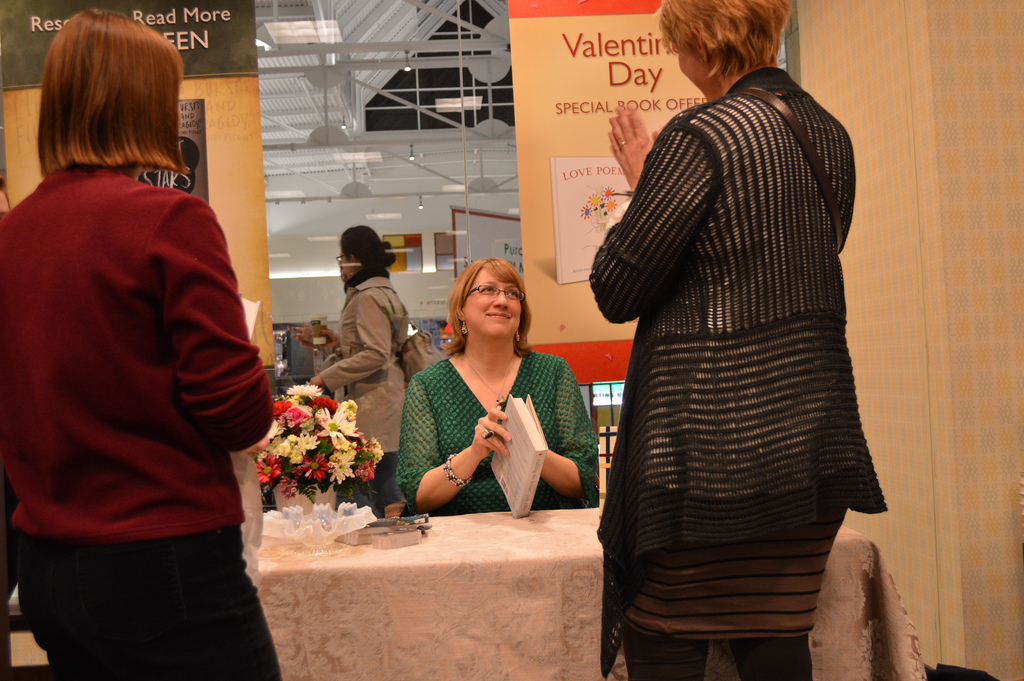
My book launch, last Tuesday evening at Barnes & Noble in Arlington, Texas, ranks right up there with the BEST days of my life.

I had an amazing labor nurse--I only met her shortly before Calling Me Home hit the nursery, but Jessica Prigg was the nicest, most gracious Community Relations Manager I could have worked with. She even provided a box of tissues to keep handy at the lectern.

My critique group looks on as I read
from Calling Me Home
Because I did cry. I think the only other time I've truly cried with joy during this long, long journey was when I called my oldest child to tell him I'd sold my book. I think that's significant, considering he was the first human baby who made me cry tears of joy.

Tuesday night, the tears started when one of my beloved critique partners from my group blog, What Women Write, asked if I was nervous shortly before the event began. When I nodded, she leaned in for a hug and whispered in my ear:

"You've got it. And if you fall, we'll catch you. We always do."

My best friend Gail and me, next to cake and flowers
from her and my critique group
What author could ask for more than that? I mean, besides well over a hundred friends, family members, former bosses and coworkers, church members, neighbors, book club members, people from my dentist office, and the list goes on ... there in the delivery room, simply to encourage and support and listen to me (ME!) talk about a story I wrote with no guarantee this day would ever happen.

I realized, as I stood before these people, that NOTHING else mattered when it comes to this book. Not the sales numbers, the Amazon ranks, the lists, the magazine or news coverage, the good or bad reviews--the good times and the bad times, whatever was and is to come for Calling Me Home.

All of that pales in comparison.

What mattered was right there in front of me.


Photo credits: Rick Mora

Friday, 1 February 2013

Conquering My Fear of Book Presentations


One of the strangest things about writing a novel is that after spending months and years alone with your thoughts, slaving away on your book, you’re supposed to get up in front of people and talk about your work as if it’s something you do every day. For those of us with little or no public speaking experience, it can be daunting to say the least. Terrifying is probably a more appropriate word.

When the local library invited me to do a signing and presentation after my debut novel released, I thought it would be a piece of cake. After all, I had directed a few community plays. I knew I could stand up and talk to a group of people. Plus, I was the first person in our area to have a book traditionally published. I knew everyone would be interested in hearing about that journey.

I was looking forward to the signing, naively confident for a number of reasons. After all, I knew my novel better than anyone. I had learned a lot about the publishing world. And I knew most of the people who would be attending the event. I thought I’d have the same excited sense of anticipation I always had when looking forward to a celebration or holiday. I thought the time leading up to the event would feel like the days before my wedding reception, when I was looking forward to seeing everyone there, smiling and waiting to congratulate me.

I couldn’t have been more wrong.

The closer it got to the day of the event, the more my stomach churned. I worked on my presentation for a day and half and blew up old family photos from WWII to use as visual aids. I practiced in the kitchen, using the clock on the stove to time myself. Then I made my first lethal mistake. Three days before the event, I asked my husband and twenty-six year old daughter for their opinion on my presentation. What I really wanted was feedback on the content, not a critique of my delivery. My second mistake was not telling them that.

I won’t go into the details here, but by the time they were finished telling me what they thought, I was in tears. I wondered what I’d been thinking, imagining that I could perform like the REAL authors I’d seen on tour. I was certain that I was about to make a fool of myself in front of the half the community. The next two days were sheer torture. I walked around with a boulder in my chest, wishing I’d never written a book in the first place. And to top it all off, I had other appearances already scheduled. There was no way I could cancel them. This was what I'd signed up for and now my worst fears were coming true. I was not going to live up to what was expected of me as a published author.

My husband did his best to make me feel better; reminding me that everyone was excited and proud of me. He said they were coming to the library because I had done something amazing and they loved my novel. He said I could stand up there and pick my nose and they’d still be thrilled to have me sign their books. (after washing my hands, of course) I wasn’t convinced. To say I was a mess would be an understatement. Then, the night before my presentation, I had a dream about a little blonde girl who looked up at me with big-blue eyes and said, “Think about it with your heart, not your head.”

Now I know it might sound silly, but the next morning a strange sense of calm had come over me. I knew the little girl in my dream was talking about my presentation. I was still nervous, but thankfully, I was no longer terrified. I’d been afraid of sounding stupid in front of everyone, of losing my place, of fumbling over words, of not being able to answer questions intelligently. Some people have vast amounts of knowledge when it comes to WWII, while others have preconceived notions. I wanted to sound like I knew what I was talking about. I wanted to sound smart.

But the little girl in my dreams was right. After all, passion lies in the heart, not in the head. If nothing else, I was passionate about my novel! I’d made the decision to write THE PLUM TREE because I’d grown up listening to my family’s stories about surviving WWII. I believed the average German civilian’s story needed to be told. How could I go wrong talking about something that was so important to me? I reminded myself that I’d done over four years of research and would be able to intelligently answer questions about that time period. When I’m passionate about something, the details stay with me. I could trust myself.

Most importantly, I reminded myself people were coming to see me because they were excited about me being a published author, not to judge me on my speaking skills, or how much I knew about WWII. They couldn’t wait to hear about the inspiration behind my novel and my journey toward publication. (okay, my husband was right) 

In the end, my presentation went a thousand times better than I could have hoped. It was pretty emotional to see over a hundred faces smiling back at me, happy to be there to support me and hear what I had to say. It’s true that you can feel the energy of an audience, and that night I felt nothing but acceptance, excitement and pride; all matters of the heart.

The audience laughed when I read a quote I thought was perfect for the occasion: “The human brain starts working the moment you’re born and never stops until you stand up to speak in public.” They grinned from ear to ear when I took pictures of them holding up their books. There were audible ‘ohs and ahhs’ during my stories about my grandparents and mother. A few people told me afterwards that they were nearly in tears. I had feared the Q & A period and it turned out to be my favorite part. Other people said I was a natural at public speaking. Go figure.

But best of all, my mother, my husband and adult children said they got choked up while I was speaking. They said I did a fantastic job and couldn’t believe what they were hearing and seeing. Since that night, I’ve done two more presentations and find myself looking forward to the next. I've made the decision to trust myself, to think to with my heart and not my head. And  so far, it's worked.

If you’re nervous about your first book presentation, here are a few tips that worked for me:

     1) Before you start, take a deep breath, smile and count to three. It gives you a little time to collect yourself.

     2) Trust yourself. You know your book and your publishing journey better than anyone in the world.

     3) Be yourself. If you try to fake it and act like someone you’re not, it will show.

     4) Remember that you are a published author!! Even with all your daily fears, frustrations and doubts, (feelings that no one in the audience knows about, by the way) the fact that you have a book published is pretty amazing and something to be proud of! Most of the audience is already in awe of your accomplishment.

     5) Break the ice. Thank the people who invited you, thank the audience, and say something funny to put them at ease. Beside the quote above (which you’re free to steal) I asked how many were there because they loved books and reading, and how many were there because they were related to me. (thanks to my BP friend, Julie Kibler) People laughed!
     
     6) Occasionally turn the attention on the audience if you can. Take a picture of them holding up your book! It worked great for me and I’m so glad I have those photos. 

     7) Have a bottle of water with you. Not only will it give you a tiny break, but your mouth will get unbelievably dry. When I said I needed a drink and took a sip from the bottle, everyone chuckled. Even this small thing will make you look personable.

    8) If you have visual aids–old photos, costumes, etc.–use them to break up your talk.

9) If you’re doing a reading along with the presentation, make it   short. Mine was seven minutes and I did it between talking about the inspiration behind my novel and how I got published.  

10)    Don’t practice in front of your family! It will turn out badly and you will lose any confidence you had. 

11)   Think about your presentation with your heart, not your head. You’re passionate about your novel, right? Use that!


Thursday, 10 January 2013

An Open Letter to Debut Authors: Five Things to Consider


Dear Debut Author,

 A year ago, when I launched my debut novel , I told myself that I would throw myself into the next twelve months and do all I could with the resources I had to bring my babe into the world. It’s been a wild and crazy ride (as Steve Martin might say).  These past twelve months, I’ve felt emotions in concentrated, hyper-potent doses. I’ve been wistful, happy, and everything in between; seasoned by all the events and people I’ve met, mistakes and victories I’ve experienced. I’m both sober and inebriated. I have a long way to go, and much to learn, but I hope you’ll consider these five things as you step into your debut year.

Thing #1 – Delight, enjoy and celebrate your launch.  You’re a debut author once. That’s it. Embrace your accomplishment.  Give yourself time to breathe in your feelings of pride and happiness—yes—happiness!  If you have to disappear into your bedroom closet to shout, do it! Hug your old clothes. Spill your pent up tears. If you start blubbering with gratitude because a bird landed on your front walk, ride the sensation—sob away. Be a sentimentalist. Be melodramatic with joy. You’ve worked hard to achieve this, harder than most people will ever understand. 

Thing #2 – Pace yourself. You will reach stations of utter exhaustion, moments when you are overwhelmed, and confused. You will tell yourself not to complain. You will tell yourself: This is my dream, how can I stop pushing, doing, trying every day?  Well, here’s a silly joke:  

“Knock. Knock.”

“Who’s there?”

“Human.”

“Human who?”

“Human who needs sleep. Human who needs routines. Human who needs healthy foods to function at debut author speed.”

Seriously. You will push harder than you thought you could. But, you will hit that wall of fatigue. You won’t know you’ve bumped into it until your head hurts and your mind is whizzing around Venus—hot and fiery. That’s when I’d like to suggest you take a break, a few days off to parent yourself.  Don’t worry. You’ll be back at it. You’ll book another reading; you’ll write another blog post, you’ll answer more q&a’s, but you must pause or you will burn up.  Your psyche will disintegrate. Respect the demands of your particular lifestyle, family and financial constraints. Surround yourself with people who make you feel good, who want the best for you.  You are the boss of your life.

Thing #3 – Beware of Goodreads Reviews. (Okay. Laugh.)  Every author I talked to forewarned me: “Goodreads is particularly nasty,” they said. “Not everyone will love your book.”  You will listen and nod and be grateful for the cautionary advice, but privately you will want to be that one exception.  You won’t be.  No one is. Not Dickens. Not Jane Austen. Not YOU.  You will get that cranky, stupid review, the one where a reader can’t or won’t understand your character, will refuse to understand why your book has swears or sex. My cheap advice?  Don’t engage. Let those nasty reviewers fade away. Most will. (You can always vent with fellow authors. They will happily vent with you.)

Thing #4 – Let surprises…surprise you.  A reader you’ve never met will fall in love with your book, rave about it, pass it on to his or her friends, blog about it, cheer you on Twitter and Facebook.  It’s not a fluke.  It’s what you hoped for but it will still come out of the blue, unexpected and thrilling. It’s one of the most wondrous events, a gift from heaven designed especially for authors.  Soak it in. 


Thing #5 – Do everything in your power not to compare yourself with other writers and their books.  Comparing is an animal that seeks out sink holes, swamps and depression.  You’ll follow it anyway. But keep a tight leash on it. Life is fickle. Readers and reviewers are inconsistent. But you can remain constant about yourself.  Don’t compare. Just don’t.

Now, return to Thing #1 - Delight, enjoy and celebrate your debut year.  Congratulations! 

Warm wishes and good luck!

Jessica Keener   
Author of Night Swim